
by | Oct 19, 2024 | Business
Social media platforms have revolutionized how we keep informed about current events, interact with people, and exchange knowledge. They play a role in shaping our communication in today’s society. Recognizing these changes is crucial for maneuvering through the media world and maximizing social media networks’ benefits.
The Democratization of Communication
The way we talk to each other today has been shaped by the media. It’s simpler for people to make and share their content now. Back in the day news mainly came from newspapers, TV, and radio. But now platforms such as Twitter, Facebook, and Instagram allow anyone with an internet connection to voice their thoughts and connect with others worldwide. This shift gives people and communities the power to have conversations express their views and showcase different perspectives without relying on traditional news sources.
The Rise of Real-Time Interaction
Social media platforms offer a way for people to express their opinions and connect with others instantly. Users can share their thoughts on posts join discussions and interact with content in real time. This swift flow of information not only spreads news but also sparks engaging conversations. Staying connected, during events and significant news moments is vital as it keeps individuals informed and involved through timely updates and active participation.
The Influence of Social Algorithms
Social media sites use algorithms to personalize content for users based on their preferences and interactions. These algorithms influence what appears in users’ feeds shaping the information that people see and engage with. While this personalization improves the experience by showing relevant content it can also lead to echo chambers where individuals mostly encounter opinions that match their existing beliefs. This effect has the power to reinforce group thinking and restrict exposure, to different viewpoints, affecting the depth of public conversations. The influence of influencers and smaller-scale influencers is noteworthy.
Media growth has introduced a group of communicators called influencers and micro-influencers. They have become well-known on platforms such as Instagram, TikTok, and YouTube by using their impact to sway opinions and set trends. Influencers tap into their image and the connections they’ve built with their followers to endorse products express thoughts and spark conversations. This change has revolutionized conventional marketing and public relations approaches as companies and entities increasingly partner, with influencers to connect with their audiences in a genuine and relatable way.
The Impact on Traditional Media
The growing impact of media is transforming the way traditional news outlets function. News organizations and broadcasters are leveraging these platforms to enrich their narratives engage with audiences and boost traffic to their websites. Social media plays a role in disseminating news interacting with viewers and enhancing brand recognition. Nevertheless, this transition presents challenges like adjusting to evolving algorithms handling audience involvement and addressing concerns regarding misinformation and misleading news content.
The Emergence of New Communication Norms
The way we talk on social media has brought about new rules and traditions that shape how we interact with others online. Emojis, hashtags, and memes let us express our feelings in ways beyond just using words. Moreover, private messages and group chats offer spaces for conversations while public posts and stories encourage engagement. It’s crucial to recognize these evolving communication norms today as they influence how our messages are perceived and understood. The Role of Media in Social Movements Social media platforms have become powerful tools for driving social change and activism. They serve as channels to organize events raise awareness and gather support for various causes. Movements like #MeToo, Black Lives Matter, and climate activism have harnessed the influence of media to spread their messages reach audiences, and bring about significant societal changes. The capacity to share information and coordinate actions highlights the profound impact that media has on shaping modern social movements and advocacy initiatives.
Conclusion
Social media has changed the way we connect. These platforms make it easier to create content that draws inspiration from traditional media while offering new ways to express ourselves. They have also changed how we communicate and share information. In this ever-changing environment, it’s important to recognize the role of media in shaping our relationships, building connections, and sparking discussions. By embracing these changes while being aware of their impact, we can leverage the potential of media platforms to improve communication and drive positive outcomes.
Coach Boost Gio

by | Oct 18, 2024 | Business
The emergence of media platforms and the impact of traditional news outlets on how we consume news highlight the importance of recognizing these shifts, for both audiences and media professionals. Over time the way we consume and interact with news has changed a lot. With the help of technology, our ways of getting and sharing information have been revolutionized.
Recently social media has become a popular way to share news. Sites like Twitter, Facebook, and Instagram allow users to quickly spread and find articles, videos, and updates keeping them up to date on current events through their feeds. However, despite its convenience social media raises issues about spreading false information and the trustworthiness of sources. News organizations are starting to use media to connect with audiences but they need to be careful to maintain accuracy and reliability. Similarly, streaming services such as Netflix and Hulu give viewers the chance to watch news documentaries and shows, at their own pace. These platforms often mix entertainment with informative content in their news programming. While streaming services provide a way to consume news they also face challenges in ensuring factual correctness and presenting diverse viewpoints. The shift towards streaming for news reflects changing audience preferences that favor content alongside traditional journalism.
The Role of Podcasts in News Delivery
Podcasts are now a way to catch up on the latest news. Many news organizations produce podcasts where they delve into subjects conduct interviews and offer their viewpoints on current events. This format enables a exploration of stories making it easier for listeners to stay informed. However striking a balance between bias and impartiality in reporting can be challenging in the podcasting realm. Nevertheless podcasts continue to be a preferred choice for news delivery due to their convenience and captivating storytelling that resonates with audiences. Social media platforms have also emerged as avenues for news dissemination. Sites like Facebook Twitter Instagram and TikTok enable users to swiftly share and receive news updates keeping them informed about breaking stories and trending topics. However the rapidity of information sharing raises concerns regarding the accuracy and reliability of news since false information can spread just as swiftly. News organizations and fact checking entities are actively addressing these issues to uphold the credibility of news shared on social media platforms.
The Role of Mobile Technology
The way we get news has changed a lot with smartphones and devices. Thanks to tech advancements people can now read articles whenever and wherever they want making it simpler to stay updated even on busy days. News apps and websites are user friendly and come with features like alerts to keep users in the loop about breaking stories. Additionally mobile devices allow us to consume news through formats like videos, podcasts and interactive articles making the news experience more engaging overall.
Personalization and Algorithmic Curation
In todays media landscape news is presented in a personalized manner. News outlets employ algorithms and thorough assessments to tailor content according to users previous online behavior and engagements. This approach helps people find articles that resonate with their preferences. However it has a drawback as it can lead to creating echo chambers where individuals predominantly encounter news that reinforces their preexisting views. This inclination may restrict exposure to perspectives and contribute to polarizing public sentiment.
The Emergence of Subscription Models
As ad revenue declines media organizations are exploring subscription models to bolster their financial standing. Subscribers can enjoy content without interruptions by paying a fee. This move towards subscriptions is driven by the need to safeguard journalism in the current environment. While these strategies offer a source of funding for news outlets they raise concerns about affordability and accessibility potentially restricting news coverage for certain groups.
The Impact of Podcasting and Audio
Podcasts are gaining traction as a way to stay updated on the news through audio formats that can be enjoyed at your convenience. News podcasts offer perspectives interviews and discussions on current events allowing listeners to engage with news stories in a more personalized and accessible way. The rising popularity of podcasting signifies a change in how individuals consume media seeking content that aligns with their preferences and lifestyle.
The Impact of Emerging Technologies
The way news is being delivered is being revolutionized by recent advancements like Artificial Intelligence (AI) and Virtual Reality (VR) technology. AI improves reporting analyzes data trends and customizes content based on personal preferences. On the hand VR provides immersive experiences that let users interact with events virtually. These innovations have the power to change how news is created and consumed by offering engaging ways for people to connect with and comprehend current events.
Conclusion
Throughout the years the way we receive news has evolved significantly due to technological progress. The rise of media platforms and personalized content has transformed how we access information. As we navigate this shifting terrain it’s crucial to recognize the impact of these changes on our capacity, to stay updated and make choices regarding news sources. Adjusting to these transformations while remaining aware of challenges such as misinformation will be essential, in nurturing an informed society and a varied media environment.
Coach Boost Gio

by Penny Angeles-Tan | Oct 18, 2024 | Business
Explore the potential rewards and risks of investing in the Bitcoin futures market. A complete guide to understanding market dynamics and making better investment decisions.
Bitcoin, as the largest cryptocurrency, continues to attract the interest of investors from various circles. One of the interesting aspects of Bitcoin is the futures market which allows traders to speculate on the price of Bitcoin without needing to buy or sell physical coins.
This article will discuss the increase in Bitcoin open interest along with an analysis of the Bitcoin futures market. Read to the end to understand the entire explanation.
Bitcoin Futures Market Analysis
Recent analysis suggests that the Bitcoin futures market may be heading into its second bullish phase. Data from CryptoQuant shows increased leverage in the BTC USDT futures market, which could be an indication of potential significant price movements.

Ki Young Ju, CEO of CryptoQuant, analyzed two important metrics: the ratio of BTC-USDT open interest to reserves and the ratio of BTC-USDT open interest to USDT market capitalization. These two metrics indicate a significant increase in leverage in the Bitcoin futures market.
Increased Open Interest
Bitcoin (BTC) open interest reached a staggering $19.8 billion at 574,680 BTC on October 15. Data from CryptoQuant reflects a significant increase in demand for the largest cryptocurrencies, indicating how much new money has entered the digital asset market in recent months.
The funding rate has surged to the highest level since August, indicating that most of those open positions are long positions expecting further appreciation.
While an increase in open interest is usually a positive indication for Bitcoin price action, some market observers have expressed concerns that increased volatility could be threatened.
The highly leveraged nature of the futures market will eventually pave the way for large-scale liquidations if and when sudden price swings occur.
According to data from Glassnode, a large number of Bitcoin futures contracts are cash-margined and not crypto-margined, meaning they are collateralized by US dollars or dollar-pegged stablecoins and not the cryptocurrency itself.
Bitcoin Price Increase Potential
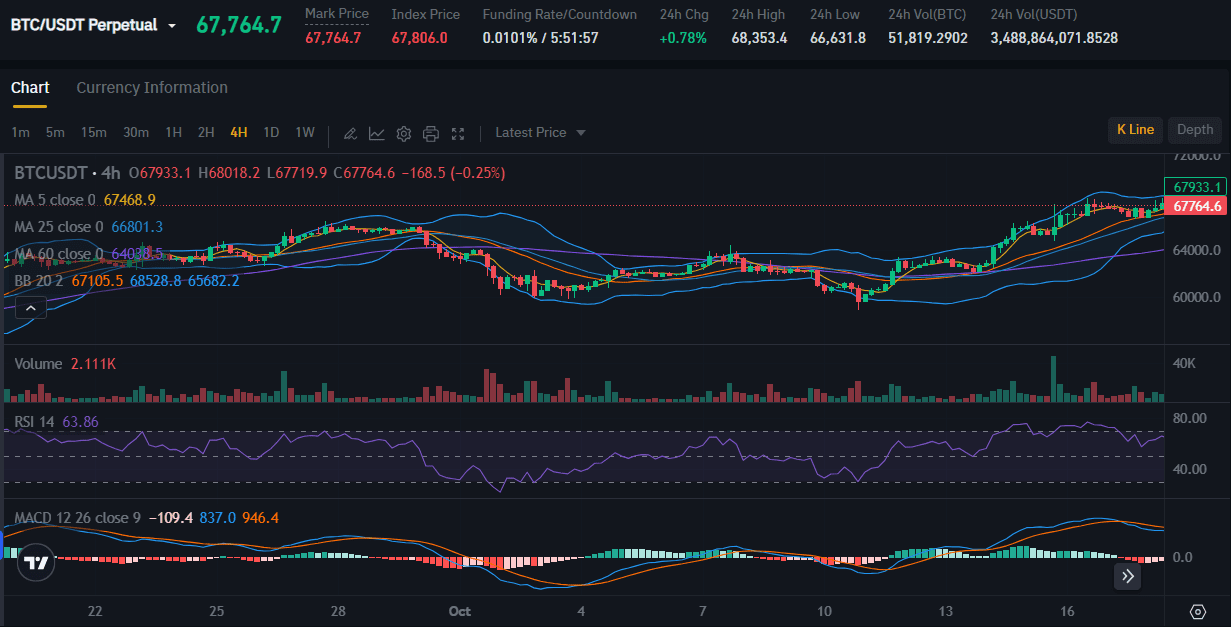
At the moment, Bitcoin price in the Bitrue futures market it was at $67,764 with an increase of 0.78%. Previously, within 24 hours, Bitcoin reached its highest price in the futures market at $68,353.
It can be seen from the BTC price chart excerpt above that the RSI value is 63, which means a trend to buy Bitcoins is much more dominant than the selling trend. However, this dominance is still within reasonable limits, not overbought.
The MACD line appears to have a downward trend, but the position of the line which is still above the threshold indicates that the BTC position is currently strong in its bullish possibility.
An increase in open interest can be a positive indication of Bitcoin’s potential price increase. However, keep in mind that the crypto market is highly volatile, and factors such as changes in regulatory policies and technological developments can affect the price of Bitcoin.
Risks to be Aware of
The crypto market is known for its high volatility, so the price of Bitcoin can experience sharp fluctuations. Changes in regulatory policies can also affect Bitcoin prices.
Using leverage can increase potential profits, but also increases the risk of loss. Apart from that, Bitcoin also faces competition from other cryptocurrencies.
Conclusion
The increase in Bitcoin open interest shows the high interest of investors in the futures market. However, keep in mind that high open interest can also increase the risk of volatility. If the market moves against a trader’s position, massive liquidations can occur.
For those of you who are interested in investing in Bitcoin in the futures market, do not immediately invest without studying current market conditions. Do your own research (DYOR) by knowing price statistics, price conversions from BTC to USD, and how the project is progressing. Knowing the fundamentals of a token is also very good for knowing where you stand as an investor.

by | Oct 17, 2024 | Business
Asuene APAC received the prestigious “Singapore Apex Corporate Sustainability Awards” at the16th GCNS Summit 2024, held at the One Farrer Hotel in Singapore on October 3-4, 2024. 
The Singapore Apex Corporate Sustainability Awards features three categories: “SustainableBusiness,” “Sustainable Solutions,” and “LowCarbonSG.” In each category, 5 to 7 companies are nominated as finalists. Asuene APAC won the Singapore Apex Corporate Sustainability Award in the “Sustainable Solutions” category.
This award is given to solution providers that have contributed to advancing sustainability in society and businesses across the APAC region, particularly in Singapore. Asuene APAC has worked tirelessly to promote its cloud service “ASUENE,” a carbon accounting platform, both domestically and regionally. The company’s efforts in promoting corporate decarbonization, along with its promising future potential, were key factors in receiving this honor.
At the award ceremony held at the One Farrer Hotel in Singapore, Masaaki Hamada, ManagingDirector of Asuene APAC, took the stage to receive the award from the Guest of Honor, Dr. Poh Koon Koh, Senior Minister of State for Sustainability and the Environment.
Asuene will continue to support global decarbonization and ESG management from our headquarters in Tokyo, our regional office in Singapore, and our base in the United States.

About the GCNS Summit
The GCNS Summit is an event organized by the Singapore chapter of UN Global Compact, focusing on corporate sustainability. This year marks the 16th edition of the summit, known as “GCNS Summit 2024.”
Due to climate change and environmental degradation, there is a growing momentum for mandatory environmental, social, and governance (ESG) reporting, including the visualization of CO2 emissions. As a result, the role and responsibility of businesses are increasingly significant.
Achieving net-zero by 2050 requires a fair transition to more sustainable business models.
In this context, the GCNS Summit serves as a platform for meaningful dialogue, collaboration, and action to promote the United Nations Sustainable Development Goals (SDGs) in the Asia-Pacific region, emphasizing the urgency and commitment needed to achieve these goals.
Over the two-day event, influential figures in corporate sustainability from the APAC region, including the President of the UN Global Compact Network Singapore and other board members, delivered speeches and presentations. The summit also included the awarding ceremony for the “Singapore Apex Corporate Sustainability Awards,” which Asuene APAC received.
GCNS Summit – Global Compact Network Singapore: https://summit.unglobalcompact.sg/
Comment from Masaaki Hamada, Managing Director of Asuene APAC
“This award represents a significant milestone for Asuene APAC. The UNGC is one of the most prestigious international organizations globally, and its Singapore chapter, GCNS, undertakes a wide range of activities related to promoting SDGs in society and business, including awareness initiatives and talent development. GCNS holds considerable influence over national policies and the business community. Receiving the esteemed ‘Singapore Apex Corporate Sustainability Awards’ from GCNS will further enhance the trust and recognition of the Asuene APAC brand both domestically and regionally. I would like to express my heartfelt gratitude to our employees, clients, and partner companies who have trusted us and contributed to our growth.”

by | Oct 16, 2024 | Business
The way media has changed over time is really impressive. Thanks to progress in technology changes in how people act and new ways of sharing content recent developments have transformed how we consume news and entertainment. Recognizing these changes is essential to staying relevant and influential in the current media scene.
Technological Progress The Age
Our interaction with content is always changing. The shift from traditional approaches to digital platforms has revolutionized the creation sharing and consumption of content. Thanks to smartphones, fast internet, and cloud technology media companies can now reach audiences worldwide. This change has led to the emergence of formats such as social media platforms podcasts and streaming services each providing distinct ways for viewers to connect with content.
The Rise of Social Media
Platforms like Facebook, Twitter, Instagram, and TikTok impact how we consume media. They do more than share content by promoting user posts and highlighting trending topics. With the power of media, people can express their views and showcase their creativity to a large audience. This shift has created an environment where influencers and independent content creators influence traditional media channels.
Content personalization and data analytics
In today’s age it’s crucial to customize content to align with individual tastes. Companies utilize information and tools to craft tailored experiences for their customers. A striking example of this trend can be found in services such as Netflix and Spotify which use algorithms to suggest movies or songs based on your past selections. Likewise, news apps personalize stories and articles according to your preferences. This move towards personalization has changed the way people perceive the significance and relevance of media.
The Emergence of Artificial Intelligence
The impact of intelligence is revolutionizing industries by boosting efficiency improving user experiences and harnessing data insights to forecast trends. In the media realm, these advancements are proving beneficial as AI contributes to creating news pieces movies and even music. Additionally, AI refines approaches to ensure that ads reach their intended audiences effectively. As AI technology continues to evolve its impact on the media landscape is set to expand presenting both obstacles and possibilities.
The Shift to Subscription-Based Models
The old way of making money through ads in the industry is running into challenges. Nowadays more and more people are opting for streaming services. Many viewers like watching their shows and movies without any interruptions. To meet this demand platforms such as Netflix, Disney+ and Hulu now have subscription plans that give access to a variety of movies and TV shows. Moreover, this trend has prompted traditional media companies to consider subscription models for news and online content. Well-known newspapers like The New York Times and The Washington Post are leading the way in this shift.
The Impact of Globalization
The way we consume content has been transformed by globalization making it simpler to access and share diverse cultural materials. Media companies now can reach audiences across the globe via streaming platforms instead of being confined to specific regions. This shift has provided viewers with choices and heightened competition, among content creators. Additionally, global media trends frequently impact markets leading to an interconnected and ever-changing media landscape.
The Challenge of Misinformation
Its concerning how misinformation and fake news are becoming more common these days. The quick sharing of news on social media and websites has made it easier for misleading or false information to reach many people. Tackling this issue requires steps like creating algorithms establishing content moderation rules and launching media education programs to assist people in assessing the information they come across.
Conclusion
The way we consume content is changing with the help of technology shifts in preferences and fresh concepts. Streaming services are gaining traction artificial intelligence is making its mark and there is an increased focus on tackling misinformation. These elements are influencing the landscape of the industry. To adapt to these transformations smoothly industry experts and viewers alike must keep themselves updated on these emerging trends as we navigate through this evolving landscape.
Coach Boost Gio





You must be logged in to post a comment.