by | Feb 28, 2025 | Business
Kuala Lumpur, Malaysia, 28th, February 2025 .
The job market in Southeast Asia is evolving rapidly, driven by digitalisation, shifting workforce expectations, and industry demand. MVC Resources, a regional player in recruitment solutions and HR services, provides an in-depth analysis of key employment trends shaping 2025.
Through extensive market research, data analysis, and industry insights, MVC Resources actively tracks employment trends and emerging developments. This enables businesses to make informed hiring decisions and helps job seekers stay competitive in an evolving job market.
By leveraging market research, industry data, and talent analytics, MVC Resources helps organisations refine their hiring strategies to match evolving workforce demands. This strategic approach ensures businesses attract the right talent for long-term growth while empowering professionals with career opportunities aligned to industry needs.
The Rise of Digital Recruitment
The digital transformation of the recruitment industry is accelerating, with Malaysia witnessing a 16% year-on-year (YoY) increase in e-recruitment activity (HCAMag). This growth highlights the increasing reliance on digital hiring tools as companies strive to improve efficiency, streamline candidate selection, and secure top talent in a competitive job market.
Across Southeast Asia, businesses are leveraging artificial intelligence (AI) and automation to revolutionise the hiring process. Platforms like Kalibrr in the Philippines and Job3s.vn in Vietnam are leading the way in AI-powered recruitment. Kalibrr has facilitated employer-candidate matching for over a decade, processing over 10 million job applications annually. Meanwhile, Job3s.vn’s AI-driven technology connects candidates with employers and was recently recognised with the Sao Khue Award 2024 in the A-IoT category for its innovation in recruitment.
Several companies in Southeast Asia are actively integrating AI-powered solutions into their recruitment strategies, some include:
– Impress (Singapore): Offers an AI-powered chatbot that conducts candidate interviews, streamlines data collection, and integrates seamlessly with existing applicant tracking systems (ATS).
– JobHopin (Vietnam): Utilises AI and machine learning to match candidates with suitable job openings, enhancing hiring efficiency.
– Snaphunt (Singapore): Provides an AI-driven platform for sourcing, interviewing, and analytics, ensuring better candidate-role matching.
– Kalibrr (Philippines & Indonesia): Incorporates AI-driven assessments and an ATS to connect employers with potential candidates, improving hiring decisions.
These cutting-edge technologies not only accelerate hiring and enhance candidate-role matching but also enable companies to anticipate future talent needs.
AI’s Role in Workforce Planning and Talent Development
Beyond recruitment, AI is playing a crucial role in workforce planning and employee development. By analysing data and predictive workforce modelling, organisations can proactively address skill shortages and optimise long-term recruitment strategies.
For instance, AI-powered platforms can evaluate individual learning styles and performance data, providing personalised training programs that enhance employee engagement and skill development. By adopting these advanced technologies, companies in Southeast Asia can future-proof their hiring strategies, secure high-quality talent, and drive sustainable business growth.
As AI continues to reshape the recruitment industry, businesses that embrace these innovations will have a competitive advantage in securing the best talent in an increasingly dynamic job market.
Industry Growth and Hiring Demand
While industries such as hospitality, retail, and logistics have experienced notable job growth, some sectors are facing stagnation or decline:
Industries Experiencing Decline:
Manufacturing: The manufacturing sector in Southeast Asia has seen a reduction in job openings, with a decrease of 13,000 positions reported in recent data . This decline is largely attributed to supply chain disruptions, rising operational costs, and a slowdown in global demand for exports, particularly in electronics and automotive production. Additionally, economic uncertainties and shifting trade policies have contributed to reduced investments in the sector (Vietnam Manufacturing Tracker: 2024-25).
Retail Trade: Employment in southeast Asian countries such as Indonesia retail trade sector has shown little net change over the past year, indicating stagnation in job growth (Reuters). This stagnation is driven by inflationary pressures affecting consumer spending, the continued rise of e-commerce reducing the need for traditional retail staffing, and corporate cost-cutting measures in response to economic uncertainties Financial Times.
Unchanged Sectors:
Utilities and Mining: These sectors have maintained steady employment levels, with minimal fluctuations reported in recent months. This stability can be attributed to consistent demand for energy and raw materials, long-term contracts in the energy industry, and the gradual transition towards sustainable energy sources, which has kept job losses at bay despite shifts in energy policy.
Further Analysis and Implications:
The contrast of growing and declining industries underscores the dynamic nature of the current job market. For employers and job seekers, this landscape presents both challenges and opportunities:
For Employers: Businesses in expanding sectors should focus on strategic talent acquisition to meet increasing demand. This involves investing in training programs, reskilling employees, and implementing retention strategies.
For Job Seekers: Individuals should stay informed about industry trends and consider opportunities in growing sectors like healthcare and digital technology. Acquiring versatile skills can enhance employability, particularly in a fluctuating job market.
Understanding these trends enables both employers and job seekers to make informed decisions, fostering resilience and adaptability in an evolving economic environment.
The Growing Importance of Soft Skills
Research highlights soft skills as a key factor influencing hiring trends. Employers now prioritise professionals with strong communication, adaptability, critical thinking, teamwork, leadership, and problem-solving abilities alongside technical expertise.
Studies reveal that 75% of long-term job success depends on soft skills, while only 25% relies on technical skills (Stanford Research Institute & Carnegie Mellon Foundation). This shift aligns with the modern workplace, where automation and AI handle technical tasks, making human-centric skills even more valuable.
For businesses, this means investing in employee training beyond technical upskilling to include leadership development, problem-solving, and emotional intelligence. For job seekers, enhancing soft skills can improve employability and career growth, especially in industries where client interaction and innovation drive success.
The Shift Towards Hybrid and Remote Work
Workplace flexibility remains a priority for job seekers, with over 60% of Malaysian professionals preferring hybrid work models (ACN Newswire). This shift is prompting companies to rethink work policies and invest in digital collaboration tools.
Implications for Employers:
– Offer Flexible Work Arrangements: Implement hybrid models to support work-life balance.
– Enhance Supportive Benefits: Provide mental health support, family planning assistance, and pet-related leave.
– Foster an Inclusive Culture: Cultivate a workplace that values flexibility, inclusivity, and employee input.
Companies that fail to offer flexible work options risk losing top talent to more accommodating competitors.
Navigating Malaysia’s Evolving Job Market
Malaysia’s labour market is transforming rapidly. Businesses must move beyond traditional hiring metrics and focus on speed, efficiency, and strategic talent acquisition. With top candidates receiving multiple offers in a short time frame, employers who prolong their hiring process risk losing high-calibre talent to more agile competitors. To stay ahead, companies must streamline recruitment processes, leverage AI-driven hiring tools, and adopt a proactive approach to securing top professionals before they are snapped up by rivals.
In a competitive HR Services landscape, MVC Resources is dedicated to helping organisations secure top talent through consultative recruitment strategies, market insights, and employer brand representation. We ensure that businesses not only attract but also retain the right talent. Our expertise in employer brand representation strengthens companies’ positioning in the job market, making them the employer of choice amidst fierce competition. With a hands-on, tailored recruitment strategy, MVC Resources empowers businesses to navigate hiring challenges and build high-performing teams.
For professionals seeking career advancement or organisations in need of expert recruitment support, visit Our Services Provided to explore available opportunities and tailored hiring solutions. For further insights and recruitment consultations, feel free to contact us.
by | Feb 28, 2025 | Business
Indonesia’s facial cleanser market saw remarkable growth in Q4 2024, reaching $78.4 million in GMV—a 212.35% increase from the previous year—driven by strong demand from Gen Z consumers. Shopee dominated online sales with an 89.36% market share, while Skintific led the category with 16.5% market share, followed by Wardah and Cetaphil. Notably, new entrant Scora gained traction with its budget-friendly cleanser, signaling a shift in consumer preferences. As competition intensifies, brands are leveraging innovation and strategic positioning to capture the growing market.
Jakarta, February 28, 2024 – Indonesia’s skincare market continues its upward trajectory, with the facial cleanser segment experiencing remarkable growth. According to Statista, the skincare market in Indonesia is projected to generate approximately $2.94 billion in revenue in 2024, with an expected annual growth rate of 4.54% from 2024 to 2030. Within this booming market, facial cleansers have emerged as a key category, driven by increasing consumer awareness, a focus on targeted skincare benefits, and the substantial influence of Gen Z consumers.
Facial Cleansers Market Overview
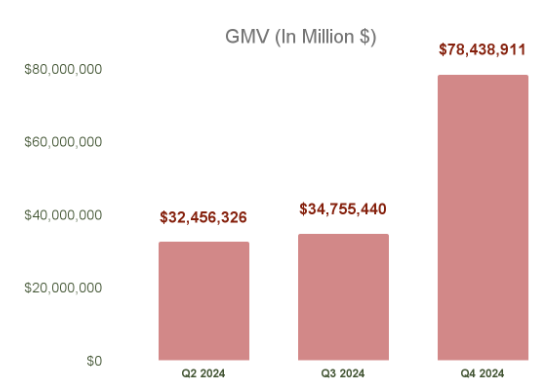
Magpie data reveals that in Q4 2024, facial cleansers accounted for 14% of the beauty category group in Indonesia’s e-commerce market, ranking third after moisturizers and serums & essences. During this period, the facial cleanser market size reached $78.4 million, marking a staggering 212.35% increase from Q4 2023, with 24 million units sold, reflecting a 163.74% year-on-year growth. Additionally, the category demonstrated strong quarter-over-quarter (QoQ) performance, with Gross Merchandise Value (GMV) rising by 125.29% compared to Q3 2024, highlighting its impressive momentum.
E-commerce Market Share and Competitive Landscape
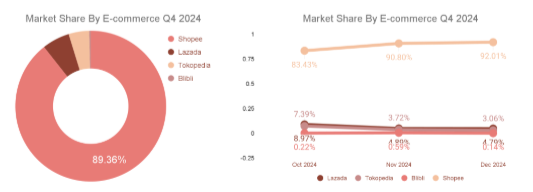
Shopee maintained its dominant position in the online facial cleanser market, securing an 89.36% market share, followed by Lazada (5.89%), Tokopedia (4.41%), and Blibli (0.33%). Shopee’s market dominance remained steady throughout the quarter, while both Lazada and Tokopedia faced challenges in maintaining their positions, and Blibli exhibited minimal movement.
Leading Brands in the Facial Cleanser Market
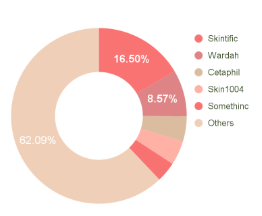
The top five brands contributed 37.91% of the total market, with Skintific leading at 16.5%, followed by Wardah (8.5%), Cetaphil (4.6%), Skin1004 (4.5%), and Somethinc (3.7%).
While Skintific retained its lead, its market share peaked at 21% in October before stabilizing at 17.7% in December. Meanwhile, Wardah demonstrated steady growth, reaching 8.7% by December, and Cetaphil and Skin1004 remained competitive, ending the quarter at 5.8% and 4.4%, respectively. Somethinc also saw significant growth, rising from 1.4% in October to 4.4% by December.
Performance by E-commerce Platform
Shopee
Skintific dominated Shopee’s facial cleanser category with an 18.19% market share, generating $12.8 million in revenue. Wardah followed at 8.02%, while Skin1004 (5.02%), Cetaphil (4.36%), and Somethinc (4.05%) rounded out the top brands.

Lazada
Glow & Lovely emerged as the top brand, capturing a 15.95% market share and generating $737.3K in revenue. Other key brands included Pond’s (7.83%), Wardah (7.41%), Garnier (5.56%), and Glad2Glow (5.3%).

Tokopedia
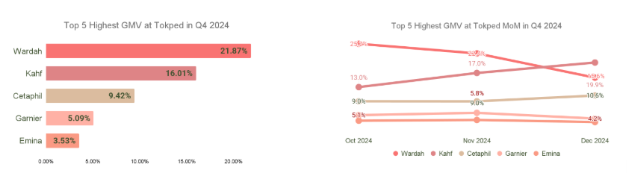
Wardah led with a 21.87% market share, generating $757.2K in revenue, followed by Kahf (16%), Cetaphil (9.42%), Garnier (5.09%), and Emina (3.53%).
Blibli
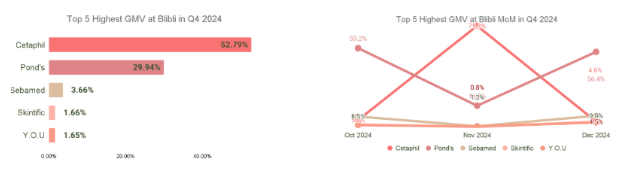
Cetaphil dominated Blibli’s facial cleanser segment with a 52.79% market share, generating $138K in revenue, outperforming Pond’s (29.94%), Sebamed (3.66%), Skintific (1.66%), and Y.O.U (1.65%).
Top-Selling Products and Emerging Players
The best-selling facial cleansers in Q4 2024 were:
- Cetaphil Gentle Skin Cleanser 500ml, generating $512.4K in revenue with 39.3K units sold, reinforcing its dominance in the premium skincare segment.
- Skintific Gentle Gel Cleanser 120ml, generating $406K in revenue with 65.4K units sold, maintaining strong consumer preference.
- Scora Salicylic Acid Low pH Cleanser 100ml, an emerging contender, achieving $359.5K in revenue with 145.6K units sold, indicating a rising demand for budget-friendly yet effective cleansers.
Looking Ahead
The facial cleanser market in Indonesia continues to exhibit strong growth, with established brands strengthening their positions and new players like Scora making significant inroads. As consumer interest in skincare remains high, brands are expected to innovate and optimize their digital strategies to stay competitive in this rapidly expanding market.
Picture by: rawpixel.com on freepik
by | Feb 28, 2025 | Business
Midori Climate Partner has completed its pre-seed round, led by Tokio Marine Holdings, to expand biochar carbon removal projects across Asia.
The funding will be used to hire key management talent and accelerate project development, with Midori Climate Partner initially launching its first biochar project in Cambodia. The company plans to expand ecosystem restoration projects including biochar across Asia.
Tokio Marine Holdings’ investment represents a strategic capital partnership aimed at accelerating market growth and innovation in the carbon credit space.
Midori Climate Partner Pte. Ltd., a carbon credit developer specializing in ecosystem restoration, has successfully closed its pre-seed funding round. The round was led by Tokio Marine Holdings (TSE: 8766), the parent company of Japan’s largest property and casualty insurance group, alongside a collection of individual investors.
*Tokio Marine Holdings, Inc. invests in Midori Climate Partner Pte. Ltd, through Tokio Marine & Nichido Fire Insurance Co., Ltd.
Ecosystem Restoration Projects Generating Carbon Removal Credits
Midori Climate Partner develops ecosystem restoration projects, including biochar soil application, agroforestry expansion, and mangrove restoration, with a strong focus on Asia. The pre-seed funding will allow the company to scale its project pipeline and deliver high-integrity carbon removal credits aligned with global sustainability goals. It is aiming to launch its first project in Cambodia in 2025 to generate more than 10,000 tCO2e of durable CDR. The projects will also improve soil health and enhance food sustainability in the region.
The company is currently hiring key management talent to lead its project development, as well as to expand its agronomy specialist team in Cambodia to customize its biochar soil application method according to soil conditions and crop types.
A Strategic Partnership for Scalable Climate Solutions
Tokio Marine, a leading global insurance provider with a longstanding commitment to sustainability, recognizes the strategic value of this partnership, strengthening cooperation between Midori Climate Partner and Tokio Marine Group. The scope of potential collaboration includes co-developing high quality carbon credit projects and innovating risk solutions for the carbon market.
“We are thrilled to welcome Tokio Marine as a strategic investor,” said Ririko Takano, Founder and CEO of Midori Climate Partner. “This partnership underscores our initiatives to accelerate climate action in the carbon credit ecosystem while leveraging each other’s expertise.
About Midori Climate Partner
Midori Climate Partner is a social enterprise dedicated to accelerating the transition to sustainable practices by providing technical and financial support to farmers, forest owners, and local communities. Its mission is to generate high-quality carbon credits while promoting ecosystem restoration and economic resilience.
Address: 111 North Bridge Road #21-01 Peninsula Plaza 179098 Singapore
https://midori-partner.com/
About Tokio Marine Holdings
Tokio Marine Holdings is the parent company for Tokio Marine Group, a global leader in insurance services with a strong commitment to sustainability and climate action. It is the largest property / casualty insurance group in Japan in terms of revenue and employs over 43,000 people in 45 countries worldwide. The Group has a proven track record in ecosystem restoration, particularly in mangrove rehabilitation projects worldwide. Through strategic investments and innovative solutions, Tokio Marine Group continues to contribute to a more resilient and sustainable future.
https://www.tokiomarinehd.com/en/
日本語プレスリリースはこちら https://midori-partner.com/press-release-20250227jp
by | Feb 28, 2025 | Business
Date: 5 March 2025
Time: 10:30 AM – 13:00 PM Jakarta Time
Registration: bit.ly/PSPMyanmar
The Regional Knowledge Centre for Marine Plastic Debris of ERIA, in collaboration with Thant Myanmar, is hosting a webinar titled “Myanmar’s Bottom-Up Circular Economy: Challenges and Opportunities in REUSE and REPAIR.” This event will showcase Myanmar’s unique approach to circular economy practices, particularly in reducing plastic consumption through reuse and repair systems.
This webinar will explore how the country’s economy functions with minimal plastic consumption and how these practices can inform circular economy strategies across ASEAN. Industry leaders and experts will share insights into innovative approaches to reuse, and repair models within consumer goods, cosmetics, and sustainable business practices. Register now to be part of the discussion!
Save the Date
Date: 5 March 2025
Time: 10:00 AM – 12:30 PM (Myanmar Time) / 10:30 AM – 13:00 PM (Jakarta Time)
Platform: Zoom
Registration: http://bit.ly/PSPMyanmar
What to Expect
Insights into Myanmar’s bottom-up circular economy, highlighting low plastic consumption models.
Case studies on reuse and repair initiatives from leading private sector actors, including sustainable beauty, consumer goods, and food industries.
Research findings on consumer behaviours and barriers to circular business models in Myanmar.
Interactive Q&A session with experts and business innovators.
Speakers Include:
Yee Yee Mon, Venus Skin Lux: Piloting Refill as a substitute for sachets.
Nilar Tun, Independent Consultant: Research on consumer goods reuse and repair.
Ngwe Tun, Genius Coffee: Challenges and opportunities in loose and reusable packaging in the food industry.
Moderator: Friedor Jeske, Programme Director, Thant Myanmar.
The event will be conducted in English, with simultaneous translation into Burmese, and e-certificates of attendance will be provided.
Don’t miss this opportunity to explore Myanmar’s innovative approaches to the circular economy. Register now and be part of the conversation!
by | Feb 28, 2025 | Business
14 wineries from the Mâcon region visited Singapore and held a successful wine tasting event at Raffles Hotel.
Located in the southern part of France’s Bourgogne region, Mâcon is an AOC region known for its exceptional natural conditions. The region’s soil, made up of limestone and clay, combined with a warm climate, allows the grapes to reach their ideal maturity, producing high-quality Bourgogne wines with a full-bodied structure and subtle mineral notes. Mâcon wines not only represent 16% of Bourgogne’s total production with an annual yield of 30 million bottles but also making it a key wine-producing area in Bourgogne. Moreover, the consistent supply and high quality of Mâcon wines have made them widely available in global markets, catering to a variety of tastes. The region is divided into 27 appellations, each with its own distinct terroir, which contributes to the wines’ diverse flavors and complexity. These factors combine to create the signature roundness and fresh fruit aromas of Mâcon wines, which, thanks to their excellent value, remain highly sought after on the international market.

On February 18th, 14 wineries from the Mâcon region visited Singapore and held a wine tasting event at Raffles Hotel. Nearly 140 industry professionals attended the event, where they had the opportunity to taste a selection of white and red wines from Mâcon. The tasting provided participants with a deeper understanding of the region’s unique terroir and wine styles. Attendees experienced a wide range of wines, from the fresh, fruit-forward Chardonnay to the light, easy-drinking Gamay reds, gaining a greater appreciation for wines from southern Bourgogne.


From Fresh to Oak-Aged: Exploring the Versatility of Chardonnay
Mâcon is renowned for its exceptional Chardonnay white wines, all crafted from the Chardonnay grape, which accounts for more than 90% of the region’s vineyards.
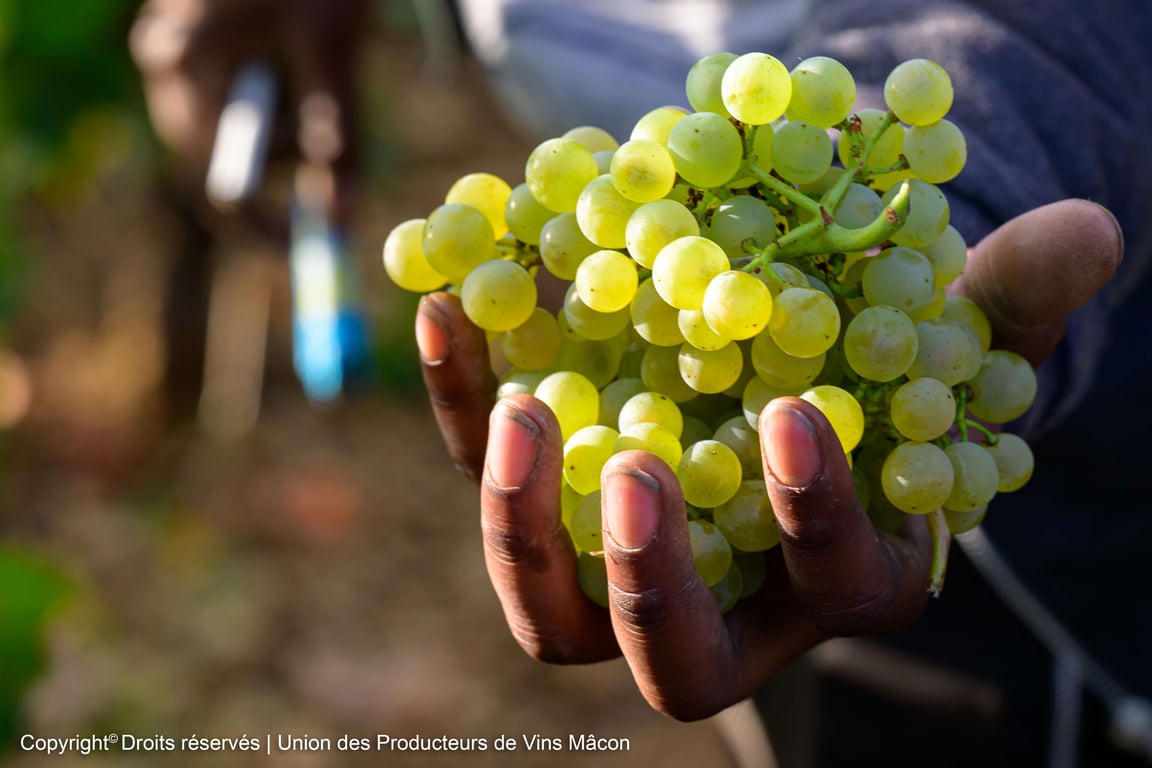
These wines are known for their pale gold to straw gold hues, often with silvery or green highlights. On the nose, Mâcon Chardonnays reveal a complex bouquet of floral aromas, such as broom, white rose, acacia, and honeysuckle, alongside herbal notes of fern, verbena, and lemongrass, complemented by citrus hints of grapefruit and mandarin.
Subtle undertones of pine, quince, and fennel may emerge in the finish. On the palate, the wines display a remarkable range of expressions depending on the terroir, offering fresh, dry, yet fruity profiles with a pleasing roundness, smooth texture, and balanced acidity—qualities that not only enhance their aging potential but also make them highly versatile for food pairings.

Delicate and Refined: Discovering the Allure of Gamay
Unique from other Bourgogne regions, where Pinot Noir predominates in red wine production, Mâcon distinguishes itself by focusing on the Gamay grape. Mâcon’s Gamay wines are known for their fresh, lively flavors, with prominent notes of raspberry and cherry, complemented by hints of spice. Thanks to Gamay’s early ripening characteristics, these red wines are light-bodied, with refreshing acidity and a smooth, rounded texture that makes them highly approachable. The fresh fruit flavors and smooth structure make these wines ideal for drinking young and offer an easy, enjoyable experience. With their vibrant fruitiness and crisp acidity, Mâcon Gamay wines are considered an excellent choice for those new to red wines, providing a rich and accessible tasting experience.
More Information

Discover more about Mâcon wines: https://www.vins-macon.com/
Learn about the terroir of the Mâcon region: https://www.youtube.com/watch?v=GF20y1aBZh8
27 reasons to love Mâcon wines: https://www.youtube.com/watch?v=-fqJ0i_8yRE





You must be logged in to post a comment.