
by | Jun 23, 2025 | Business
Manila, Philippines — June 23, 2025 — Taxumo, the trusted online tax filing platform, has partnered with Cebuana Lhuillier, one of the Philippines’ largest and leading microfinancial services provider, to empower Filipino entrepreneurs through accessible business loans and empower MSMEs with simplified tax compliance.
A Partnership Rooted in Empowerment
“Filipino entrepreneurs face unique challenges, from complex tax regulations to limited access to financing. This partnership brings together the strengths of Taxumo’s seamless tax filing system and Cebuana Lhuillier’s trusted loan offerings to provide a holistic support system,” said Geraldine Arboleda, CEO at Taxumo.
For Cebuana Lhuillier, the partnership is an extension of its long-standing mission to uplift underserved sectors. “For over 35 years, we’ve helped Filipinos access financial tools once out of their reach. This collaboration with Taxumo is a powerful next step—connecting the dots between financial access and responsible business growth. It’s about fueling ambition, and backing that ambition with real, timely support,” said Jean Henri Lhuillier, President & CEO of Cebuana Lhuillier.
Taxumo subscribers can now apply for Cebuana Lhuillier’s Microbusiness Loan directly through the Taxumo platform, allowing for a streamlined process that integrates income verification and loan application in one place.
Loan Offerings Tailored to Entrepreneurs’ Needs
Cebuana Lhuillier’s Microbusiness Loan caters to diverse business needs, including working capital, inventory financing, equipment purchases, and short-term cash flow support. Key features include:
Exclusive benefits for Taxumo users include priority loan processing and reduced documentation requirements, recognizing their commitment to responsible business management.
Driving Real Growth for Filipino Entrepreneurs
This partnership is already making an impact for many, from sari-sari store owners to ride-hailing drivers, providing timely access to capital that helps businesses restock, upgrade equipment, and manage cash flow gaps.
Cebuana Lhuillier guarantees strict data privacy, transparency in lending terms, and ethical collection practices, with ongoing financial education through their Kanegosyo Center —a dedicated hub that offers free training, resources, and mentorship to help micro and small business owners grow and sustain their enterprises. Taxumo subscribers are encouraged to explore this opportunity to unlock the financing they need to elevate their businesses.
For more information, visit www.taxumo.com or Taxumo’s Instagram, Facebook, and Tiktok Pages.
by | Jun 22, 2025 | Business
Ethereum teeters near $2,500 amid rising sell pressure, DeFi outflows, and geopolitical chaos. With options expiry looming and ETH/BTC at a critical level, is a breakout, or breakdown, inevitable?
Ethereum (ETH) has returned to a pivotal support level around $2,500, following a convergence of bearish catalysts, ranging from declining investor activity and rising technical resistance to geopolitical instability and market-wide liquidations.
As the market braces for continued volatility, analysts are watching both the ETH/BTC ratio and global risk factors for signs of what’s next.
Options Expiry Spurs Volatility Ahead of Key Price Decisions
One of the most immediate sources of price tension is Ethereum’s upcoming options expiry. With more than 56,000 ETH contracts set to expire on June 21, split between approximately 33,000 call options and 23,500 puts, traders are positioned for significant price action.
According to data from Laevitas, much of the open interest is concentrated near current price levels. This alignment raises the likelihood of ETH gravitating toward the “max pain” point, where the highest number of options expire worthless, amplifying short-term volatility.
Investor Confidence Wanes as DeFi Outflows Accelerate
Ethereum’s Total Value Locked (TVL) in decentralized finance (DeFi) has dropped from 28 million ETH in early May to just over 25 million, representing a 10% contraction in six weeks.
The rapid outflow, highlighted by DefiLlama, signals either profit-taking behavior or a shift in capital to other chains or assets.
This cooling enthusiasm across DeFi platforms suggests speculative capital is retreating, with investor sentiment shifting from growth to caution.
Technical Headwinds Limit Recovery Attempts
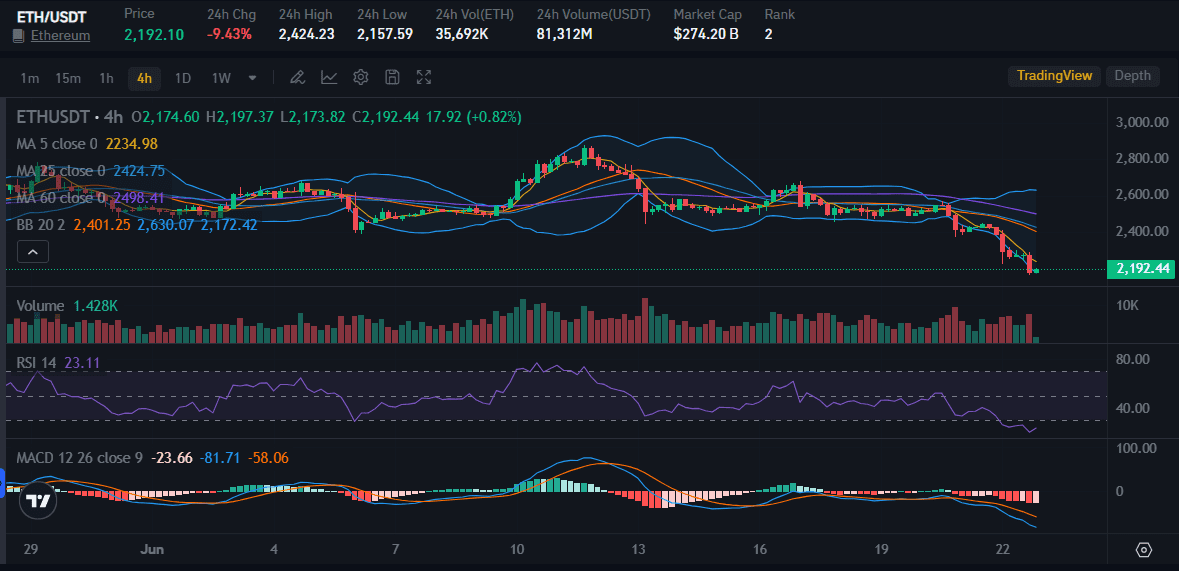
ETH’s price has struggled to breach the $2,565 resistance, which coincides with the intersection of the 100-day and 200-day Simple Moving Averages (SMA). After a brief attempt to rally, ETH was rejected and fell back below $2,500, prompting fears of a deeper correction.
Heightened trading volume during the recent decline further supports a sell-off narrative. Analysts are now watching key levels:
- Support: $2,475 and $2,385
- Resistance: $2,525 and $2,700
A confirmed break below support could trigger a slide toward $2,385, while a push above $2,525 might renew bullish momentum.
ETH/BTC Ratio at Crucial Turning Point
The ETH/BTC ratio is another crucial metric. Analyst M-log1 noted the ratio has approached a long-tested support line, with bulls defending it eight times in recent weeks. With seller momentum fading, there’s an 80% probability of a breakout to the upside, M-log1 estimates.
If ETH begins outperforming BTC, this could usher in a broader altcoin rally, a sentiment echoed by analyst Daan, who pinpoints 0.026 BTC as a breakout threshold for Ethereum dominance.
Macro Risks: Middle East Tensions and U.S. Policy Add Fuel to the Fire
Ethereum’s price weakness is also unfolding against a backdrop of mounting geopolitical tension and restrictive monetary policy. Bitcoin has already plunged below $100,000 (a psychological and technical threshold) after the U.S. and Israel bombed Iran, with fears the conflict could expand regionally.
Compounding this, Iran’s parliament has reportedly approved closing the Strait of Hormuz, which handles 20% of global oil traffic. A complete shutdown would not only spike oil prices but also dent global risk appetite, historically bad news for crypto assets.
ETH Exchange Activity Suggests Bearish Tilt — But Long-Term Accumulation Grows
Ethereum has seen four straight days of net inflows to centralized exchanges, totaling 285,000 ETH, according to CryptoQuant.
This trend indicates sustained sell-side pressure. Meanwhile, futures open interest surged by 720,000 ETH, likely driven by short positions, contributing to over $163 million in ETH liquidations in just 24 hours.
Still, structural signs remain encouraging:
- Accumulation addresses (wallets with no history of selling) have grown by 5 million ETH in June.
-
Staked ETH has reached a record high of 35.1 million, with 500,000 ETH added in just two weeks.
-
New Ethereum addresses are rising, hitting 800K–1M weekly.
These trends suggest long-term confidence remains intact, even as short-term traders adjust to volatile conditions.
Chart Watch: ETH Poised at Triangle Apex
ETH is approaching the apex of a symmetrical triangle, bounded above by the 200-day SMA and below by the 50-day EMA. A decisive breakout could define Ethereum’s next leg:
- Bullish breakout: Targets $2,850 and possibly $3,000.
-
Bearish breakdown: Risks retesting support near the 100-day SMA.
Technical indicators like the RSI and Stochastic Oscillator lean bearish, but neither is deeply oversold, suggesting room for further downside before a rebound.
Conclusion: Ethereum at a Crossroads
Ethereum stands at a defining moment. Despite clear signs of short-term bearish momentum, critical support at $2,400 has not yet broken. Meanwhile, ETH’s correlation to Bitcoin and global risk sentiment remains high, with the ETH/BTC ratio potentially triggering a larger altcoin recovery, or collapse.
In the days ahead, traders and investors should closely monitor:
- Options expiry outcomes
- $2,400 support and $2,700 resistance
- ETH/BTC ratio movement
-
Geopolitical developments and oil prices
If Ethereum can hold its ground and break above $2,700, the path toward $3,000 remains viable. But failure to do so, especially in a risk-off environment, could spark a deeper retracement.
by | Jun 22, 2025 | Business
Europe takes the lead in the global crypto market with MiCA regulation, as U.S. retail activity declines and Trump’s high-stakes crypto deals raise questions. Discover how EU clarity is beating American uncertainty.
Europe is quietly winning the global crypto war. With the implementation of the Markets in Crypto-Assets (MiCA) regulation at the start of 2025, the European Union has taken a commanding lead over the United States, despite President Donald Trump’s public endorsement of crypto.
As American retail activity slows and legal uncertainty drags on, Europe’s unified framework is unleashing a new wave of institutional and retail investment.
MiCA Triggers a Surge in EU Trading Volumes
According to Paybis co-founder Konstantins Vasilenko, trading volumes from European Union customers jumped an astonishing 70% quarter-over-quarter in Q1 2025, right after MiCA officially took effect on January 1.
This spike wasn’t about frequency, it was about volume. “The number of trades hardly moved,” Vasilenko said, suggesting larger and more deliberate investments from newly confident investors.
Meanwhile, crypto activity in the U.S. moved in the opposite direction. Platforms like Robinhood reported a 35% drop in crypto trading, and Coinbase saw retail participation shrink to just 18% of total spot trading volume, down from 40% in 2021.
“The timing is hard to ignore,” Vasilenko added.
What MiCA Gets Right: Clarity, Consistency, and Confidence
The MiCA framework introduces a single licensing regime across all 27 EU member states. Once licensed in one country, crypto firms can operate across the entire bloc, giving companies scalability and investors peace of mind.
Several major platforms have already secured MiCA licenses.
Beyond licensing, MiCA implements a series of investor protections modeled on Europe’s financial instruments directive (MiFID), including:
- Clear disclosures
- Cooling-off periods
- Transparent fee structures
-
Full-reserve requirements for stablecoins
-
Independent audits and asset segregation
These policies have significantly reduced regulatory ambiguity and restored investor confidence in the EU crypto market.
France Leads, Germany Builds, Netherlands Connects
France has emerged as a clear standout within Europe, thanks to its early 2019 PACTE law, which laid the groundwork for MiCA. Paybis reported a 175% increase in crypto activity in France in Q1 2025.
Fintech hubs like Station F and the proactive approach by France’s financial regulator AMF are helping crypto adoption soar, with national crypto usage expected to reach 24% penetration this year.
Elsewhere:
- Germany is building institutional infrastructure, with Deutsche Boerse’s Clearstream preparing to offer crypto settlement.
-
The Netherlands stands out for its robust payment systems and strong connectivity in the digital asset space.
As Vasilenko notes, “Liquidity pools in Frankfurt or Paris, customer support in Dublin, and compliance ops in Vilnius — all under the single MiCA umbrella.” The idea of a single “crypto hub” is becoming obsolete.
U.S. Falls Behind Despite Trump’s Rhetoric and High-Profile Crypto Ventures
While Europe builds, the U.S. dithers. Despite vocal support from Donald Trump and select members of Congress, the country still lacks cohesive federal crypto legislation. Regulatory uncertainty has paralyzed both investors and institutions.
As Vasilenko puts it: “State-by-state money-service licenses, unresolved SEC lawsuits, and sudden delistings mean ordinary users still can’t tell which coins, or even which staking products, will be available next month.”
Even Trump’s own crypto dealings appear mired in opacity.
Trump’s Crypto Empire: Bold Moves, Quiet Sales
Trump launched World Liberty Financial in September 2024, promising a “financial revolution.” The venture sold tokens with controversial terms, tokens couldn’t be resold, and 75% of proceeds after the first $30 million reportedly went to Trump and his family.
By early 2025, the Trumps and their partners had sold over $750 million worth of tokens. A new stablecoin, pegged to the U.S. dollar, attracted a $2 billion investment from a UAE firm. Yet behind the scenes, the Trumps began quietly divesting:
Their stake in World Liberty fell from 75% to 60% in January, then down to 40% by mid-June, according to subtle changes on the company’s website.
If World Liberty is valued similarly to Circle, whose stock tripled after going public, Trump’s divestments could have netted $135 million personally.
This aligns with Trump’s renewed focus on monetary policy. He recently attacked Fed Chair Jerome Powell, calling him a “moron” and a “numbskull,” and hinted he may fire him if interest rates don’t come down. His criticism comes amid a record $37 trillion U.S. debt load and rising interest payments.
Glimmers of Hope: The GENIUS Act and Stablecoin Reform
There may still be hope for the U.S. crypto scene. The GENIUS Act, now moving through Congress, could create a federal licensing regime and clear definitions for stablecoins, potentially echoing Europe’s MiCA.
If passed before the end of 2025, Vasilenko believes the law “would do for U.S. retail what MiCA just did for Europeans.”
Meanwhile, Circle’s successful public debut has reignited interest in crypto’s mainstream potential. The Senate recently passed a stablecoin regulatory bill, and markets are now eyeing Federal Reserve action in July, which could trigger a fresh Bitcoin rally.
Bitcoin Holds Strong Above $100K Amid Macro Uncertainty
Bitcoin has remained resilient, trading above $100,000, despite geopolitical risks and volatility. Analysts say its performance underscores its growing status as a safe-haven asset, similar to gold.
As Elliot Johnson of Bitcoin Treasury Corporation puts it, “Bitcoin’s recent strength… is a testament to its growing appeal as a long-term treasury asset.”
David Hernandez of 21Shares agrees: “Bitcoin’s fundamental properties—its scarcity, decentralization, and neutrality, make it an increasingly relevant asset for navigating an uncertain future.”
Conclusion: The Regulatory Divide Is Reshaping the Global Crypto Map
As Europe pushes forward with MiCA, and the U.S. grapples with internal divisions and politically charged ventures, the crypto balance of power is shifting.
While Trump’s brand may still move markets, it is Europe’s clarity, coordination, and consumer protections that are winning investor trust.
For now, Europe has the edge. But if Washington can unify around a framework like GENIUS, the race may soon become competitive again.

by | Jun 22, 2025 | Business
The crypto market plunged as the U.S. and Israel launched airstrikes on Iran’s nuclear sites, sending Bitcoin below $100K and triggering over $1B in liquidations. Rising geopolitical tensions and inflation fears spark panic selling across digital assets.
The cryptocurrency market experienced a dramatic downturn over the weekend as geopolitical tensions erupted following the U.S. and Israel’s coordinated airstrikes on Iran’s nuclear facilities.
Bitcoin plummeted below the critical $100,000 threshold, and major altcoins followed suit, triggering mass liquidations and sparking fear across risk markets.
Tensions Ignite: U.S. Bombs Iranian Nuclear Sites
On Sunday, June 22, the global geopolitical landscape was rocked after the United States, under orders from former President Donald Trump, joined Israel in launching targeted airstrikes on three Iranian nuclear sites, Fordow, Natanz, and Isfahan.
Trump declared the mission a “complete and total success,” aiming to dismantle Iran’s nuclear enrichment infrastructure. Iran, meanwhile, vowed swift retaliation, deepening fears of a broader Middle East conflict.
According to the New York Times, this military action dramatically escalates tensions in a region already teetering on the brink, prompting immediate shockwaves across financial markets, especially crypto.
Crypto Market Turns Red: Bitcoin Breaks Below $100K
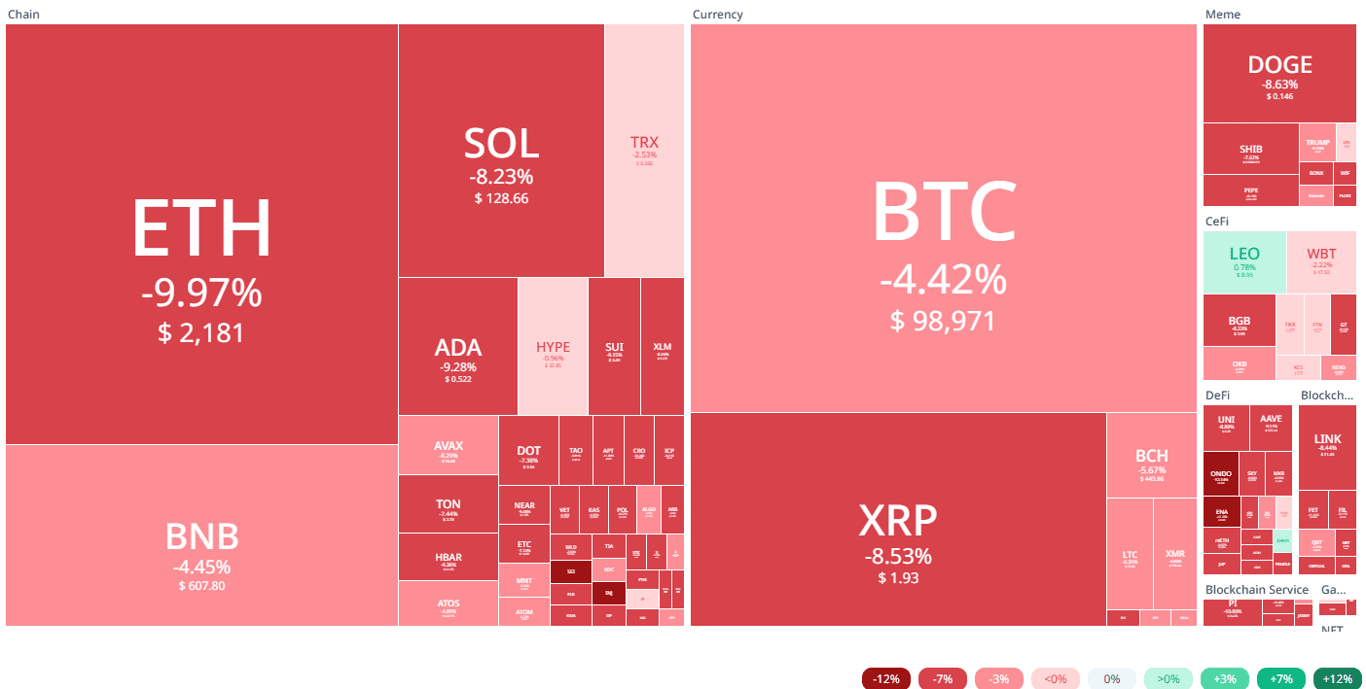
The crypto market reacted instantly to the news. Within hours of the airstrikes, Bitcoin’s price crashed by over 4%, falling from a stable $103,000 to as low as $98,971. This marks the first time in over 40 days that BTC traded below the $100K psychological support level.
Key Crypto Price Drops:
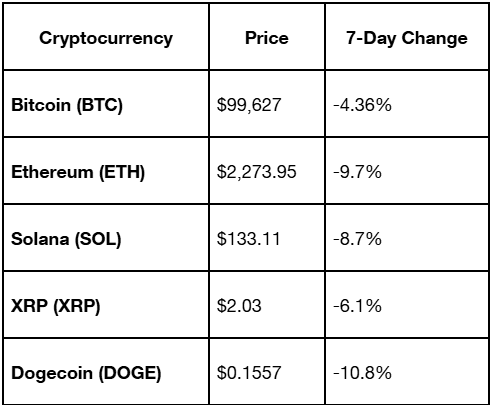
Virtuals Protocol, Celestia (TIA), Aptos (APT), and AB were among the hardest-hit altcoins, all losing over 9% in the past 24 hours.
Massive Liquidations and Market Fear
CoinGlass data revealed that total liquidations surged by 38% to over $682 million in a 24-hour span, with $1 billion in total crypto value wiped out across exchanges. Most of the liquidations targeted high-leverage positions in Bitcoin, Ethereum, and Solana.
The fear was palpable. Trading volume in Bitcoin spiked over 33%, indicating that panic selling—not normal trading, was driving the market activity. Altcoin segments such as AI tokens, including FET and VIRTUAL, lost nearly 10%, while Cardano (ADA) approached a three-month low.
Why Did Crypto Crash? Two Core Reasons
1. Risk-Off Sentiment Amid Geopolitical Uncertainty
Historically, major geopolitical events trigger a “risk-off” sentiment in financial markets. Investors flee from volatile, riskier assets—like crypto and equities—and pile into safe-haven assets such as gold, the U.S. dollar, and government bonds.
Hanain Malik of Tellimer told Bloomberg:
“Short-term, markets such as crude oil, stocks, and crypto will pivot on whether Iran retaliates and widens the war in a way that impacts oil supply versus backing down and offering concessions on its nuclear program.”
2. Inflation and Fed Policy Concerns
Oil prices surged following the strikes, with Brent crude and WTI up over 32% from yearly lows. Shipping costs are also climbing, signaling that U.S. consumer inflation could spike again. This would pressure the Federal Reserve to maintain higher interest rates longer than previously expected.
Last week, the Fed kept rates steady at 4.25%–4.50% and hinted at two rate cuts in 2025. But surging oil and inflation fears could derail those plans, which is bearish for crypto, as digital assets tend to perform better in low-rate environments.
Market Outlook: What’s Next?
With Bitcoin hovering just above $99,000 and Ethereum sliding below $2,300, traders are bracing for more volatility in the coming days. Analysts warn that if Iran retaliates, Bitcoin could dip to $95K or even lower.
The next 48 hours are critical. Any signal of an Iranian counterstrike or prolonged conflict could intensify the sell-off. On the flip side, a diplomatic de-escalation could provide temporary relief and possibly trigger a market rebound.
Conclusion
The U.S.-Iran conflict has once again highlighted the vulnerability of crypto markets to macro and geopolitical shocks. As tensions escalate, traders and investors are adopting a cautious stance.
With more than $1 billion wiped out in a day and sentiment turning defensive, the crypto market enters a critical phase.
All eyes are now on Tehran and Washington. The outcome of this standoff may determine whether Bitcoin finds a new floor—or continues its descent below five-digit territory.

by | Jun 22, 2025 | Business
Bitcoin’s current rally is drawing eerie comparisons to 2017, but Real Vision CEO Raoul Pal believes this crypto cycle could stretch into 2026. Meanwhile, rising geopolitical tensions in the Middle East and fears over oil disruptions are sending shockwaves through global markets and triggering high volatility across BTC, ETH, and XRP.
The crypto market is undergoing a storm of macroeconomic momentum and geopolitical shockwaves, prompting analysts to draw parallels with previous bull cycles, most notably the landmark rally of 2017.
Raoul Pal, CEO of Real Vision and former Goldman Sachs executive, believes that the current environment shares “spooky” similarities to 2017, yet is also setting the stage for an even longer and more volatile crypto cycle, potentially stretching into 2026.
Simultaneously, escalating Middle East tensions, fueled by a sudden U.S.-Israel-led strike on Iranian nuclear facilities, have sent shockwaves through global markets.
The aftermath has triggered dramatic price swings in Bitcoin, Ethereum, XRP, and broader risk assets, while threatening global oil supply and further inflaming inflation fears.
Bitcoin’s Trajectory Echoes 2017, But the Cycle May Be Extended
According to Pal, Bitcoin’s current market behavior eerily mimics the trend seen in 2017, when BTC climbed steadily throughout the year before its historic December breakout. In 2017, Bitcoin soared from $1,044 in January to $14,156 by December, a staggering 1,255% gain.
However, this time may be different. Pal emphasizes that macroeconomic indicators, especially his “business cycle score”, signal we’re still early in the broader economic upcycle, and that could extend the crypto bull run for years.
“It’s spookily similar to 2017,” Pal said. “But this cycle could go longer, possibly into Q2 2026, especially with the weakening U.S. dollar acting as a tailwind.”
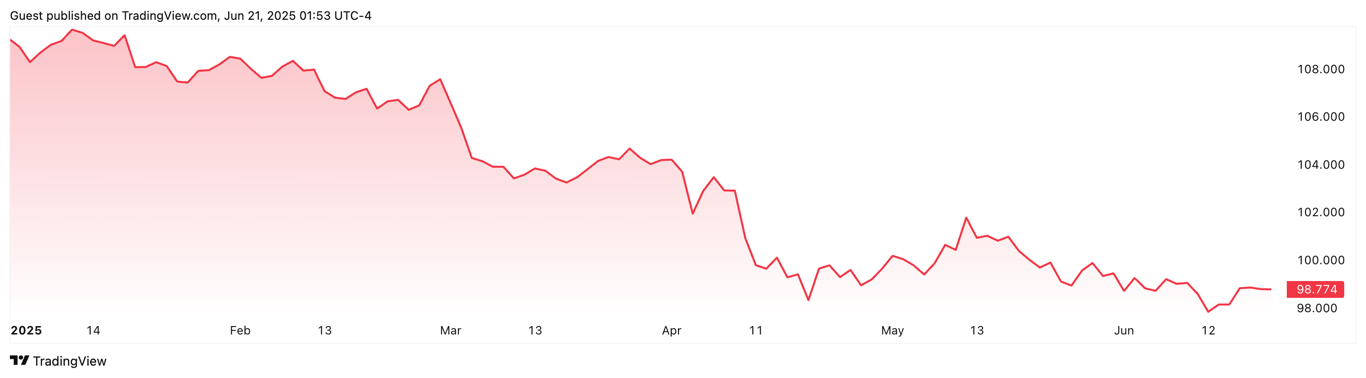
Indeed, since the start of 2025, the U.S. Dollar Index (DXY) has dropped nearly 9%, sitting at 98.77, making Bitcoin more attractive as both a speculative asset and a potential hedge against fiat debasement.
Macro Tailwinds and Institutional Adoption Fuel Market Optimism
Pal pointed out that macro forces, especially delayed interest rate adjustments and a stagnating dollar throughout much of 2024, have caused the crypto cycle to shift and potentially expand.
“The whole cycle got shifted because rates didn’t get adjusted,” he noted. “This looks more like 2020 than 2021, it feels like the earlier stages of a bull market.”
Meanwhile, the Middle East is rapidly emerging as a crypto hub. On a recent trip to the region, Pal met with several Sovereign Wealth Funds across Saudi Arabia, UAE, Bahrain, and Qatar. Their verdict?
“The mandate across the region is clear: AI and blockchain. Governments aren’t just investing in Bitcoin, they’re building entire infrastructures on the blockchain,” Pal reported.
This growing institutional interest suggests that long-term capital is entering the space, potentially cushioning crypto against the typical boom-bust patterns.
Chaos in the Middle East: War and Oil Choke Points Shake Crypto
However, just as macro tailwinds offered optimism, geopolitical tensions have rattled investor confidence.
On Saturday, the U.S., alongside Israeli forces, launched coordinated strikes on Iranian nuclear facilities in Fordow, Natanz, and Isfahan. In retaliation, Iran fired 27 missiles into Israeli territory, hitting targets in Tel Aviv, Haifa, and the Golan Heights.
The chaos reverberated across markets:
- Bitcoin crashed to $100,945 within minutes of the announcement, shedding over $40 billion in market cap.
- It later rebounded slightly to $102,350, but warning signs remain.
- Ethereum (ETH) and XRP also suffered, falling to their lowest levels in weeks.
Technical indicators aren’t reassuring either. Bitcoin is testing the $102K level repeatedly. A fresh “death cross” (when the 50-day SMA falls below the 200-day SMA) and tightening Bollinger Bands point to potential further volatility.
Strait of Hormuz in Focus: A Looming Economic Catastrophe?
Further compounding the market turmoil is Iran’s potential move to block the Strait of Hormuz, a strategic waterway handling around 20% of global oil supply. According to reports, over 50 large oil tankers scrambled to flee the region following the U.S. strikes.
Market analysts, including JPMorgan, have warned that oil prices could surge to $130 per barrel, pushing U.S. inflation to 5%—levels not seen since early 2023. Such a spike could force the Federal Reserve to reconsider future rate cuts, tightening financial conditions and possibly triggering broader risk-off sentiment.
Crypto as a Safe Haven—or Risk Asset?
These events reinforce a growing debate: Is Bitcoin a safe haven, or merely another speculative asset?
In times of economic uncertainty, Bitcoin has historically attracted capital as a non-sovereign store of value. However, during acute crises, especially those with global military implications, it often reacts like a high-risk tech stock.
Still, some analysts believe these conditions set the stage for another breakout. Historically, long periods of consolidation, like the one Bitcoin is currently experiencing—have preceded parabolic moves.
Conclusion: A Battle Between Macro Optimism and Geopolitical Fear
The crypto market is currently walking a tightrope. On one side are powerful macro tailwinds, institutional adoption, and weakening fiat currencies, elements that mirror the bullish backdrop of 2017 and 2020.
On the other side lies geopolitical instability that threatens to short-circuit global markets.
With sovereign funds betting big on blockchain, and the global economy just beginning to recover, the longer-term outlook for crypto remains bullish.
But in the short term, expect turbulence as markets digest war headlines, oil price shocks, and uncertainty in the Strait of Hormuz.
As Raoul Pal put it, “The cycle’s not over—it might just be getting started.”
by | Jun 22, 2025 | Business
Ripple’s XRP faces renewed volatility amid rumors of U.S. government seizure and legal uncertainty with the SEC, while stablecoin RLUSD rapidly approaches a $500M market cap. Could Ripple’s bold stablecoin push shape XRP’s future?
The crypto market was rattled over the weekend by fresh speculation involving Ripple and its flagship digital asset, XRP. On June 22, XRP slid another 8.13%, closing at $1.9378.
The drop came as rumors circulated that the US government could seize Ripple’s escrowed XRP holdings to build national crypto reserves, a theory floated by crypto analyst John Squire.
However, legal expert and pro-crypto attorney Bill Morgan swiftly debunked the claim, stating, “No, it won’t.” Despite this, the narrative gained just enough traction to spook investors already on edge.
XRP Legal Drama Continues: The Judge Torres Factor
XRP’s downward trend isn’t just about baseless government seizure theories. The ongoing lawsuit between Ripple and the U.S. Securities and Exchange Commission (SEC) remains the primary cloud over the token.
After a prior procedural rejection, Ripple and the SEC jointly filed a renewed motion on June 12, asking Judge Analisa Torres for an indicative ruling that could finally lift the ban on XRP sales to institutional investors and reduce the $125 million penalty.
Since Judge Torres rejected the initial motion quickly—within seven days—investors are now growing uneasy due to the silence following the second motion.
Why does this matter? A favorable ruling could end the multi-year lawsuit and open the door for XRP spot ETF approvals, unlocking a potentially massive price surge. Conversely, a rejection could trigger exchange delistings, ETF rejections, and further price erosion.
Ripple’s Strategic Countermove: RLUSD’s Meteoric Rise
Amid the courtroom drama, Ripple is making bold moves elsewhere. Most notably, Ripple has minted 13 million RLUSD tokens, pushing the total supply of its stablecoin close to $500 million.
According to Etherscan and data from CoinGecko, this brings RLUSD’s market cap to approximately $428.7 million, putting it in the sights of industry giants like Tether (USDT) and Circle (USDC).
RLUSD’s growth has been strategic, fast, and targeted, with recent token batches flowing into wallets linked to major liquidity pools.
Analysts believe these tokens are headed for listings on centralized exchanges (CEXs) and decentralized finance (DeFi) platforms, further boosting RLUSD’s real-world utility.
The Big Picture: RLUSD, XRP, and Ripple’s Multi-Chain Vision
Despite being a Ripple product, RLUSD is currently issued on Ethereum rather than the XRP Ledger (XRPL).
However, integration with XRPL and other blockchains is reportedly in the works, aligning with Ripple’s multi-chain strategy to expand its ecosystem’s influence.
Ripple’s partnerships are also strengthening RLUSD’s utility. A notable alliance with AlchemyPay now enables RLUSD access via major fiat payment networks like Visa, Mastercard, and Apple Pay.
Regulatory wins, including licensing in Dubai, suggest RLUSD is poised for broader global adoption.
This all feeds into speculation that RLUSD may indirectly support XRP’s valuation by anchoring Ripple’s ecosystem in regulated, liquid, and widely adopted assets.
XRP Price Outlook: A Game of Legal Dominoes
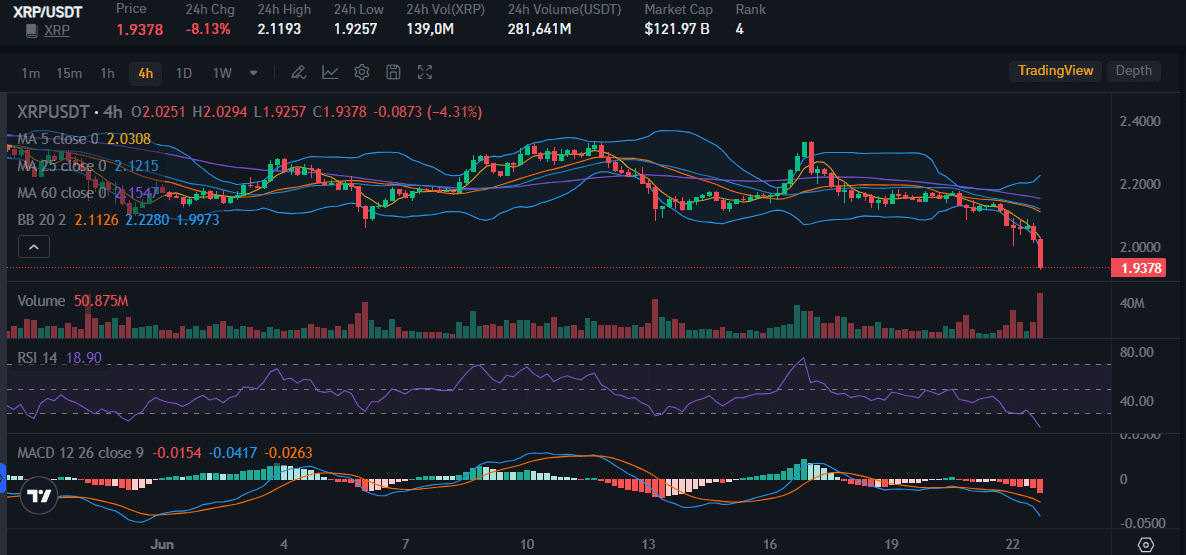
XRP currently trades under both its 50-day and 200-day Exponential Moving Averages (EMA)—a technical red flag. At the time of writing, the 14-hours RSI sits at 18.90, indicating that XRP may still have room to fall before entering “oversold” territory below RSI 20.
If Judge Torres rules in Ripple’s favor:
- XRP could break above $2.2, reclaim $2.6553, and aim for 2025’s high of $3.3999.
- Spot ETF approval could follow, potentially driving XRP to record highs above $3.5.
But if the motion is rejected or delayed:
- XRP could fall below $2.
-
The next support lies at $1.9299, and a drop toward $1.5 is not off the table.
Macro Factors: Beyond the Courtroom
XRP’s trajectory is also tied to broader market variables:
- Global conflicts like Iran-Israel tensions.
-
US tariffs and the impact on crypto-friendly trade policies.
-
Federal Reserve decisions on inflation and interest rates.
-
Political dynamics, especially if former President Trump’s pro-crypto agenda gains traction.
These variables all converge to create a highly volatile environment for XRP investors.
RLUSD: The Trojan Horse for Institutional Adoption?
Institutional interest may spike as Ripple’s stablecoin nears the $500M threshold. According to market watchers, this level is more than symbolic—it represents trust, maturity, and reliability for enterprise players.
Further bolstering confidence is RLUSD’s wallet distribution. No single wallet holds an overwhelming supply, indicating healthy decentralization and lowering risk, key considerations for banking and institutional partners, including persistent rumors of Ripple’s collaboration with Bank of America.
Ripple’s Future: Legal Resolutions, Stablecoin Expansion, and Institutional Dreams
Ripple CEO Brad Garlinghouse has made it clear: the legal battles won’t stall innovation.
The company’s ambitious plans for RLUSD, alongside XRP’s potential to process up to 14% of SWIFT’s global transactions within five years, paint a picture of a firm not merely surviving regulatory scrutiny but preparing to thrive beyond it.
Conclusion: A Tale of Two Tokens
The XRP price remains at the mercy of Judge Torres and SEC decisions. But Ripple isn’t standing still.
Through RLUSD, it’s laying the groundwork for a more robust, diversified crypto ecosystem. Whether RLUSD will lift XRP, or simply replace it as Ripple’s flagship asset, remains to be seen.
For now, all eyes remain on the courtroom, but savvy investors are starting to look beyond it.
Stay tuned for further updates on the XRP lawsuit, Ripple ETF developments, and the rise of RLUSD in the fast-moving world of crypto finance by subscribe Bitrue blog.

by | Jun 22, 2025 | Business
Addressing inefficiencies in high-volume Philippine BPO recruitment, MyGlit is an AI platform providing instant resume-to-job matching for candidates and automated screening tools for employers. Purpose-built for BPO roles, it aims to become the go-to portal for faster, more transparent hiring.
MANILA, Philippines – June 22, 2025 – The Philippines’ vital BPO sector, a major employer facing persistent recruitment challenges, is seeing a new approach to talent matching. MyGlit, an AI-powered job platform built specifically for high-volume hiring, has been operational in the Philippines since 2018, focusing on improving efficiency and transparency for both employers and job seekers.
The platform addresses common pain points: candidates often apply “blindly” with low response rates, while recruiters struggle with high application volumes and time-consuming manual screening. MyGlit tackles this by providing instant, AI-driven feedback to candidates on their resume’s fit for each role (“Select,” “Reject,” or “Consider”), helping them target applications more effectively.
For BPO companies like Teleperformance, EXL, and Foundever – already leveraging MyGlit across Metro Manila, Cebu, and regional hubs – the platform offers automated CV-to-job description matching and recruiter performance analytics. This aims to reduce initial review time and improve the accuracy of shortlisting.
“The goal isn’t AI making final decisions, but giving everyone involved – candidates and recruiters – clearer signals and faster feedback loops,” said Akhil Ahluwalia, Founder of MyGlit. “We’re building MyGlit to become the go-to platform for efficient and transparent BPO hiring in the Philippines.”
Key Solutions for the Philippine BPO Market:
Reducing Blind Applications: Shows candidates immediate fit feedback, helping them apply smarter.
Improving Recruiter Efficiency: Automates initial screening based on BPO role requirements (voice, non-voice, shift-based).
Enhancing Transparency: Provides candidates with clearer application status updates.
Built for Scale & Compliance: Designed for high-volume processing while adhering to Philippine data privacy regulations and GDPR.
Positioning for Recognition:
Unlike general job boards, MyGlit is purpose-built for the unique demands of the Philippine BPO recruitment market. Its focus on AI-driven matching, candidate transparency, and recruiter performance analytics positions it as a specialized solution targeting core inefficiencies within the region’s BPO job portal sector.

About MyGlit:
MyGlit is an AI-driven recruitment platform focused on high-volume BPO hiring. By automating initial resume evaluation and providing recruiter analytics, MyGlit supports companies and candidates primarily in the Philippines, while expanding its platform to India, Kenya, Nigeria, and Malaysia. The platform is dedicated to simplifying large-scale recruitment while enhancing the quality of job matches for both employers and job seekers. Learn more at https://www.myglit.com.

by | Jun 20, 2025 | Business
Fathers don’t always ask for much—but behind the strong front are long hours, sore muscles,
and a well of unspoken exhaustion. This Father’s Day, it’s time to turn the tables. Let’s not just
thank Dad. Let’s give him something he rarely asks for but absolutely deserves–rest.
OGAWA Philippines invites you to celebrate the heart of the home with the Meister Massage Chair—a next-generation wellness experience designed for the ultimate relaxation and recovery. It’s more than just a massage chair. It’s your dad’s new personal sanctuary.
Introducing the OGAWA Meister: For the Man Who Does It All
The OGAWA Meister Massage Chair, now officially launched in time for Father’s Day, redefines what it means to give back to Dad. Every inch of this chair was built to support the ones who support us.
From early mornings at work to late nights fixing what’s broken, the Meister is a thank-you in the form of advanced wellness technology—delivered with luxury, comfort, and care.
Next-Level Features Fit for a Hero
Powered by Overseer Technology, the Meister doesn’t just massage—it understands. Its AI Fatigue Measurement and AI Analysis & Program Recommendation systems scan and assess the body, then intelligently recommend the ideal massage for your dad’s current state.
With 25 automatic massage programs to choose from, the Meister makes sure every muscle gets the attention it deserves—whether it’s a deep tissue session after a long day or a gentle unwind before bed.
The Meister also includes:
Voice Control for hands-free convenience
Electrical Muscle Stimulation (EMS) for targeted relief
Over-The-Air Technology for seamless updates and added programs
It’s not just a chair—it’s a wellness companion that evolves with your dad’s needs.
Make His Comfort a Priority—Now More Than Ever
This Father’s Day, the OGAWA Meister is available at a special promo price of only ₱299,000.00 (down from ₱429,000.00 SRP).
And with up to 36 months installment through partner banks, giving Dad the luxury he’s long put off is now easier and more accessible than ever.
Because Dads Deserve More Than Just a Tie
This year don’t settle for a generic gift. Give Dad what he truly deserves: peace, quiet, and a chair that treats him like the king of the house.
Visit any OGAWA showroom nationwide to experience the Meister for yourself or explore the full collection at www.ogawaworld.net.ph.
Let Dad sit back, relax, and feel appreciated—not just on Father’s Day, but every day.
Operating at full capacity with over 30 stores nationwide, OGAWA branches include key locations in One Ayala Makati, Greenhills Mall, Gateway Mall 2, Shangri-La Plaza, SM Megamall, Greenbelt 5, Lucky Chinatown Mall, Robinsons Manila, Ayala Malls Vertis North, Eastwood Mall, Robinsons Magnolia, SM Fairview, SM North EDSA The Block, TriNoma, UP Town Center, Promenade Greenhills, Alabang Town Center, Evia Lifestyle Center, Ayala Malls Manila Bay, SM BF Parañaque, and Newport Mall. For those outside Metro Manila, OGAWA can also be found in SM City Bacoor, Ayala Solenad 3, SM Sta. Rosa in Laguna, SM Seaside City Cebu, SM Lanang Premier in Davao, SM Clark in Pampanga, and SM City Olongapo Central.
by | Jun 20, 2025 | Business
Investors want to open self-managed super funds, to invest in cryptocurrency, and make use of artificial intelligence, found investment platform moomoo Australia and New Zealand in its recent survey of share investors.
But a key finding was that the complexity and cost of opening a SMSF is stopping those interested in opening a fund from doing so.
SMSF complexity holds investors back
Moomoo aims to simplify the complex setup of SMSFs, which is why 24% of interested Australians say they haven’t opened a fund. At the same time, moomoo and its partners offer a transparent range of fees to reassure the 21% of people that cite costs as their reason for not opening a SMSF.
A key third reason interested Australians hold back from opening a SMSF is not knowing what to invest in (24%). So, moomoo is providing a broad range of news and content, including from SMSF experts, to help investors manage their super to deliver for the long term.
“There are clear, legitimate reasons that even those Australians familiar with share investing and interested in opening a self-managed super fund, haven’t done so. We answer these concerns head on with our trading account service, administration partner services, and sophisticated investing resources,” says moomoo Australia and New Zealand chief executive officer Michael McCarthy.
Not only can investors use moomoo to set up a SMSF trading account, but also our partners for investment guidance, and other services including fund setup, rollovers, reporting, compliance and ongoing management.
They want to make use of artificial intelligence
Most Australian share investors (67%) would use artificial intelligence in their SMSF investing, found moomoo Australia.
Specifically, survey results show a third would use AI for their SMSF investment strategy, while 37% would use it to analyse individual investments. A third would also use AI to help manage the fund, and almost 30% to meet compliance requirements. Just over a quarter of respondents would use AI tools to meet all four needs.
“Australians’ recognition of the power of AI to lessen the burden of managing a SMSF is particularly interesting given that they cite the complication of opening a SMSF as a leading reason for not doing so,” explains Mr McCarthy.
“This need comes at the right time for moomoo, with our AI assistant launching this month. Combined with the platform’s other AI-powered features, including our trend projection and market monitoring automation, we’re using the full power of artificial intelligence to really help investors make easier, smarter, more informed trades.”
An appetite for cryptocurrency
Australians interested in opening a SMSF are far more likely to trade Bitcoin than those who already own a self-managed super fund, found moomoo Australia.
Almost two thirds (60%) of those interested in SMSFs are either trading or want to trade cryptocurrencies, particularly Bitcoin (88%) and Ethereum (56%). Almost a third are interested in stablecoins and altcoins.
But for the more conservative current SMSF owners, just over half (55%) are trading crypto or would like to. And they’re far more diversified in their interest, with 40% trading or wanting to trade Bitcoin, a third focused on memecoins and a sizeable minority (27%) on stablecoins.
“There is strong investor interest in cryptocurrency. And the moomoo platform provides for them, with access to more than 26,000 securities across the Australian, US and Hong Kong markets, including a broad range of crypto-based stocks and exchange-traded funds,” says Mr McCarthy.
About the survey
Moomoo Australia surveyed 153 sharemarket investors experienced in trading and managing superannuation (independent of the moomoo platform). About one third of respondents held a self-managed super fund, with 22% interested in opening one.
Characteristics of those that own or would like to own a SMSF are quite similar. Generally, aged over 45, they work full time with a household income between $50,000 and $150,000. Those not yet running a SMSF have less share-trading experience (about one year) and are less confident in their investment knowledge (describing themselves as ‘intermediate’).
Australians that invest in shares and hold a self-managed super fund, or want to:
are either intermediate (41%) or advanced (35%) in their level of investment knowledgebelieve their retirement balance can be up to $200,000 (23%), $500,000 (32%), $1m (26%)would use AI investing tools (67%), to strategise (33%) and analyse investments (37%)believe AI is great for SMSF reporting (37%), management (37%), but isn’t secure (31%).
Those that haven’t yet set up a SMSF:
haven’t done so because they’re satisfied with their current fund (55%), see the process as too complex (23%) or don’t believe they have enough funds (23%)would want to invest in Australian stocks (76%), property (55%), crypto (39%), ETFs (30%)would not invest in crypto (36%), futures (24%), bonds (18%), non-US global stocks (18%).

by | Jun 20, 2025 | Business
Neil Gregori Garen
Ever felt like your usual weekend getaways just don’t cut it anymore? Looking for a destination that clears your head and fills your soul at the same time?
A quick flight away, Sa Pa, Vietnam might just be the shift in rhythm you didn’t realize you needed. With its mist-covered peaks, rich cultural roots, and sweeping views, this highland haven is ideal for young professionals in search of something beyond the usual.
A highlands escape that feels far from everything
In a world filled with rushed weekends and familiar destinations, Sa Pa offers something rare: a peaceful place that still feels alive. Located in the mountainous north of Vietnam, it feels like a retreat but still gives you a mix of adventure, culture, and clarity.
We visited this June, and it felt like walking through a dream. The mountain air was cool, the mist clung to the terraced hills, and the views were so wide and open you couldn’t help but pause and take them in. Located in Lào Cai Province, Sa Pa combines stunning landscapes with rich cultural roots. It’s a great option for young professionals who want more than just beaches or busy cities—and who still have the energy for long walks, uphill treks, and scenic descents.
Even getting there is part of the experience. From Hanoi, we took a sleeper bus where you can actually lie down and enjoy a built-in electric massage. Shoes aren’t allowed inside, but the driver provides plastic covers. At the two bus stops along the way, free slippers are available so you don’t have to put your shoes back on. The five-hour ride was smooth, and a shuttle was already waiting when we arrived to take us to our hotel. Everything went seamlessly. After that, exploring the town was easy—walkable streets, friendly locals, and a slower pace that lets you breathe.
Once you’re in town, something might catch your eye. The name “Sa Pa” has a space in it, and that’s actually the proper way to spell it in Vietnamese. Still, you’ll see plenty of signs that use “Sapa” as one word. It’s nothing to stress over, since both versions are commonly used and understood by everyone.
Culture at the base, heaven at the peak
The town of Sa Pa has its own quiet charm. An old French colonial church stands in the town square, framed by mountains. Around it, you’ll find restaurants and shops offering everything from local noodle soups to European-style comfort food. Many local dishes are perfect for vegans or those who enjoy a healthy balance of meat and vegetables—think hearty broths, stir-fried greens, and fragrant herbs. During our visit, we even met fellow Filipinos exploring Sa Pa. Some were trying out Vietnamese phrases like cảm ơn (thank you), while others taught locals to say salamat. To our surprise, many shopkeepers already knew the word—proof of the warm and growing connection between cultures.
Not far away is Cat Cat Village, home of the Black Hmong people. We walked past traditional wooden houses, saw handmade indigo fabric being dyed, and joined a cultural show filled with dancing and stories from the tribe’s past. Visitors are also welcome to try on traditional clothes. The whole experience feels natural and welcoming.
But the most unforgettable part of the trip was reaching the top of Fansipan, the highest mountain in Vietnam. It’s often called the Roof of Indochina.
This journey is part of Sun World Fansipan Legend, a modern mountain resort complex that still respects tradition. It starts at Hotel de la Coupole. From there, you ride the Muong Hoa funicular, which travels through hillsides and tunnels with great views along the way. At the top station, you transfer to the Fansipan cable car. It’s one of the longest and highest cable cars in the world, floating above forests and clouds. The 15-minute ride offers peaceful and amazing views that you won’t forget.
Once you reach the summit, everything feels calm and sacred. Stone steps guide you to temples, pagodas, and giant Buddha statues, all partly hidden by the mist. Prayer flags wave in the wind while clouds pass close to your face. It’s a quiet and moving place. The best time to go is from March to June or September to November. But even if the weather is foggy, it’s still a special experience.
High adrenaline, deep perspective
If you’re looking for more excitement, Sa Pa has that too. Rong May Glass Bridge, also known as Cloud Dragon, is a clear walkway suspended high above a forested valley. You can also try the zipline, glass elevator, sky bike, and a narrow suspension bridge that follows the same dizzying route as the sky bike. With the ground far below and only glass or cables beneath you, it’s the kind of thrill that makes your palms sweat before you even step forward.
After that, we found the Bản Mòng Alpine Coaster, Sa Pa’s most modern mountain slide. You control your speed as you glide past tall pine trees and sweeping hillside views. It’s fast, fun, and safe enough that we couldn’t resist going for another round.
What truly stands out is the involvement of the local community. Tourism is growing, but many residents remain at the heart of it. Some run homestays, while others lead treks through rice terraces and hill tribe markets. It’s not just a destination to check off — it’s a place where stories and everyday life are openly shared with visitors.
Discover Sa Pa, Vietnam before the crowds do
In Sa Pa, you don’t have to choose between adventure and culture. You get both, all in one place.
For young professionals tired of deadlines and digital overload, this mountain town offers something rare, a true break. It’s the kind of trip that stays with you, not because of the photos you take but because of how it makes you feel.
So go now, while your legs still love the climb and your heart’s still curious. Go before it becomes another crowded stop. Go while Sa Pa still feels like a secret — one worth keeping, but even better when shared.
About the author: Neil Gregori Garen finds poetry in plane tickets and meaning in misty mountains—writing so others can feel it, too.






You must be logged in to post a comment.