by | Apr 20, 2025 | Business
Navigating the treacherous world of crypto scams: Learn from the insidious rise of SnapeDex and its imitators. Understand their deceptive tactics, from fake rewards to fee-based traps, and discover crucial red flags to protect your investments. Stay vigilant and informed to avoid becoming the next victim in this growing ecosystem of deception.
The allure of quick riches in the cryptocurrency market has, unfortunately, spawned a parallel ecosystem of sophisticated scams that prey on both novice and experienced investors.
The SnapeDex fraud serves as a stark warning, emblematic of a broader and deeply troubling trend: the systematic exploitation of users through deceptive promises, fee-based traps, and the untraceable siphoning of funds.
As cryptocurrencies continue to gain mainstream attention, it’s crucial to understand how these scams operate and how to protect yourself.
The Modus Operandi: How the SnapeDex Scam Worked

SnapeDex presented itself as a generous crypto reward platform, enticing users with the seemingly irresistible offer of 0.31 BTC (approximately $20,000) simply for registering. This initial lure is a common tactic in the world of crypto scams.
The deception unfolded as follows:
1. Illusory Rewards: Upon signing up, users were greeted with an artificially inflated wallet balance, creating the illusion of instant wealth. This psychological manipulation is designed to build trust and encourage further engagement.
2. Fee-Based Baiting: When users attempted to withdraw their supposed reward, they were met with a series of demands for “network fees” or “verification charges.” These initial payments, often relatively small, act as the hook, drawing victims deeper into the scam.
3. Escalating Demands and Delays: After the initial payment, victims faced a variety of scenarios, none of them leading to the promised payout. They might encounter additional fee requests, perpetual withdrawal delays, or outright account lockouts.
4. The Nonexistent Bitcoin: The promised Bitcoin reward was, of course, a mirage. No real cryptocurrency ever existed, and the entire operation was designed to defraud users.
This deceptive model, while disturbingly effective, is not unique to SnapeDex. It represents a common structure employed by crypto scams worldwide.
A Growing Ecosystem of Deception: SnapeDex’s Imitators
SnapeDex is just one example within a much larger and rapidly expanding ecosystem of deceptive digital entities.
Many of these scams operate under names that closely resemble legitimate crypto platforms, making it even more challenging for users to discern the truth.
Here are some prominent cases that mirror SnapeDex’s fraudulent methodology:
1. BTCRevolution.cloud & Bitcoin Revolution: These platforms promised unrealistic profits through automated trading bots and often leveraged fake endorsements from celebrities and media personalities to enhance their credibility.
2. AlphaWallet.net: This scam posed as a secure wallet service, only to vanish with users’ stored funds, highlighting the dangers of trusting unverified platforms with your assets.
3. Coinegg (ceggcc.vip) & vexjex.cc: These fake exchanges were linked to “pig butchering” scams, a particularly insidious form of long-term grooming that culminates in manipulated losses and significant financial damage.
4. Apyeth Gifts (apyeth.gifts): This scam masqueraded as a giveaway platform for NFTs, ultimately stealing users’ private keys and draining their wallets.
5. Clubillion.io: This operation claimed to be a blockchain-based social network while secretly operating as a Ponzi scheme, demonstrating the deceptive power of combining social media trends with financial fraud.
6. Topkex.com, Gccmoney.org, Trustpips.com, and Expert Capitals: These platforms impersonated legitimate exchanges, freezing withdrawals and demanding additional fees before abruptly disappearing, leaving users with no recourse.
These scams frequently employ a range of deceptive tactics, including phishing, fake trading interfaces, and social manipulation. They may impersonate influencers, livestreamers, or trusted brands to gain the confidence of unsuspecting victims.
The Anatomy of a Crypto Scam: Recognizing the Red Flags
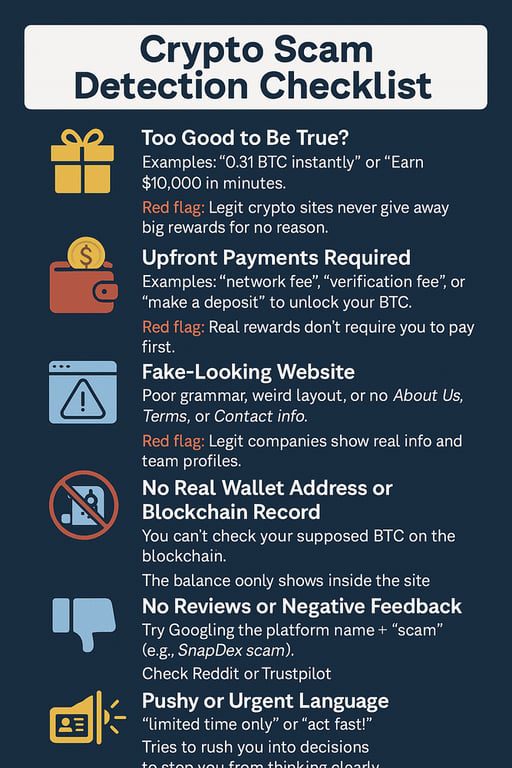
To protect yourself from falling victim to these elaborate schemes, it’s crucial to be able to identify common scam hallmarks:
1. Unrealistic Promises: Be extremely wary of any platform that offers free crypto with minimal effort or guarantees exceptionally high returns. Scams often use the lure of easy money to bypass users’ skepticism.
2. Upfront Fees: Legitimate platforms rarely, if ever, demand payment before providing access to rewards or balances. Fees labeled as “unlock charges,” “tax deposits,” or “verification fees” are a major red flag.
3. Fake Wallet Interfaces: Many scams display convincingly real-looking balances that are, in reality, simply hard-coded into the interface. Do not be fooled by a visually appealing dashboard.
4. Anonymity and Lack of Transparency: If a platform lacks a clearly listed team, verifiable company details, or genuine social proof, proceed with extreme caution. Transparency is essential in the crypto space.
5. Impersonation: Scammers often mimic the branding of trusted crypto exchanges or use slight misspellings in domain names to deceive users. Always double-check the website address.
6. High-Pressure Tactics: Be wary of time-limited offers or warnings that funds will be forfeited unless you act quickly. These tactics are designed to manipulate your emotions and pressure you into making hasty decisions.
Recovery: A Difficult but Not Entirely Impossible Endeavor
Cryptocurrency transactions are generally irreversible, and once funds are transferred to scam wallets, they are often laundered rapidly through mixers or converted into privacy coins to obscure their origin. This makes recovery extremely challenging.
However, under certain circumstances, there may be a possibility of recovering lost assets:
1. Regulated Exchanges: If the initial payment was made through a regulated exchange that adheres to Know Your Customer (KYC) and Anti-Money Laundering (AML) procedures, there may be a chance to trace or freeze the funds.
2. Credit Card or Bank Transfers: Victims who used credit cards or bank transfers should immediately contact their providers to initiate a dispute or chargeback. Time is of the essence in these situations.
3. Prompt Reporting and Blockchain Forensics: If the fraud is reported quickly, blockchain forensic experts may be able to trace the movement of funds and flag associated wallets. These services specialize in analyzing blockchain transactions to identify illicit activity.
4. Legal Action and Coordinated Reporting: Filing legal complaints and reporting the fraud to relevant authorities, such as the FBI’s Internet Crime Complaint Center (IC3), the Federal Trade Commission (FTC), or local law enforcement, can initiate broader investigations, especially if multiple victims report the same wallet addresses.
It’s important to acknowledge that even with advanced tools like Chainalysis or CipherTrace, most crypto scam cases are closed without restitution, particularly when the perpetrators operate from unregulated jurisdictions or use decentralized systems with limited oversight.
Prevention: The Most Effective Defense
Given the low recovery rates and the constantly evolving nature of these scams, prevention remains the most reliable protection.
Here are some core prevention strategies:
1. Be Skeptical of Unrealistic Promises: Exercise extreme caution when encountering platforms that offer large crypto incentives with no clear business model. If it sounds too good to be true, it almost certainly is.
2. Verify Legitimacy: Always verify the legitimacy of any platform through official channels, such as CoinMarketCap, CoinGecko, or trusted news sources. Do not rely solely on information provided by the platform itself.
3. Conduct Thorough Research: Perform reverse image searches and WHOIS checks to assess the domain’s age and ownership. Look for user reviews and independent analyses of the platform.
4. Engage with Verified Communities: Join verified crypto communities on platforms like Reddit or Twitter to stay informed about emerging scams and share experiences with other users.
5. Prioritize Security: Use hardware wallets to store your cryptocurrency and never, under any circumstances, share your seed phrases or private keys, regardless of how trustworthy a site may appear.
Snapdeal vs. Snapdex: A Crucial Distinction
It’s important to distinguish between legitimate entities and fraudulent operations. In the context of cryptocurrency, it’s essential to understand the difference between Snapdeal and Snapdex.
1. Snapdeal: This is a reputable Indian e-commerce platform established in 2010. It allows customers to make purchases using cryptocurrencies through third-party payment solutions, offering a convenient way to integrate crypto into online shopping.
2. Snapdex: This term has been associated with a cryptocurrency scam that lures users with promises of free Bitcoin and then defrauds them through various fees and deceptive tactics.
It is critical to avoid confusing the two. Snapdeal is a legitimate business, while Snapdex, in its reported context, is a dangerous scam.
The Perils of “Free BTC” Offers: The Snapdex Case Study
The lure of “free BTC” is a common tactic employed by crypto scammers. The Snapdex case provides a clear example of how these schemes operate.
Snapdex enticed users with the promise of 0.31 BTC (worth a significant amount of money) simply for signing up. This seemingly generous offer is a classic red flag.
The scam unfolded as follows:
1. Enticing Offer: Snapdex advertised the free Bitcoin offer, often accompanied by fake endorsements from public figures to create an illusion of legitimacy.
2. Fake Balance Display: Upon registration, users were shown a fake dashboard displaying a balance of 0.31 BTC, reinforcing the deceptive narrative.
3. Withdrawal Trap: When users attempted to withdraw the funds, the platform demanded various fees, such as “network fees” or “verification fees,” which users were required to pay in real Bitcoin.
4. No Payout: After users paid the fees, they received nothing. The platform would either demand more payments, delay the withdrawal indefinitely, or simply lock the user out of their account.
5. No Real Bitcoin: The promised Bitcoin never existed. The displayed balance was a purely visual trick to deceive users.
Conclusion: Vigilance and Informed Skepticism
The cryptocurrency landscape, while offering exciting opportunities, is also fraught with risks. The proliferation of scams like SnapeDex underscores the critical importance of vigilance and informed skepticism.
By understanding the common tactics employed by scammers, recognizing the red flags, and adopting robust prevention strategies, you can significantly reduce your risk of becoming a victim.
Remember, in the world of crypto, if an offer seems too good to be true, it almost certainly is. Always prioritize caution, conduct thorough research, and never let the fear of missing out cloud your judgment.
by | Apr 20, 2025 | Business
XRP News Today: Get the latest on XRP price analysis, including crucial legal settlement updates in the Ripple vs. SEC case, growing momentum for a potential XRP ETF, and the ongoing battle between investor hope and expectation.
XRP (XRP-USD), one of the most watched altcoins in the crypto sphere, is once again under the spotlight. As of mid-April, XRP is trading around $2.08, experiencing moderate consolidation after recent highs of $2.14.
Despite this seemingly modest price action, the cryptocurrency finds itself at a critical junction—where legal clarity, renewed institutional interest, and macroeconomic trends all converge to shape its near- and long-term future.
A Tale of Consolidation Amid Volatility
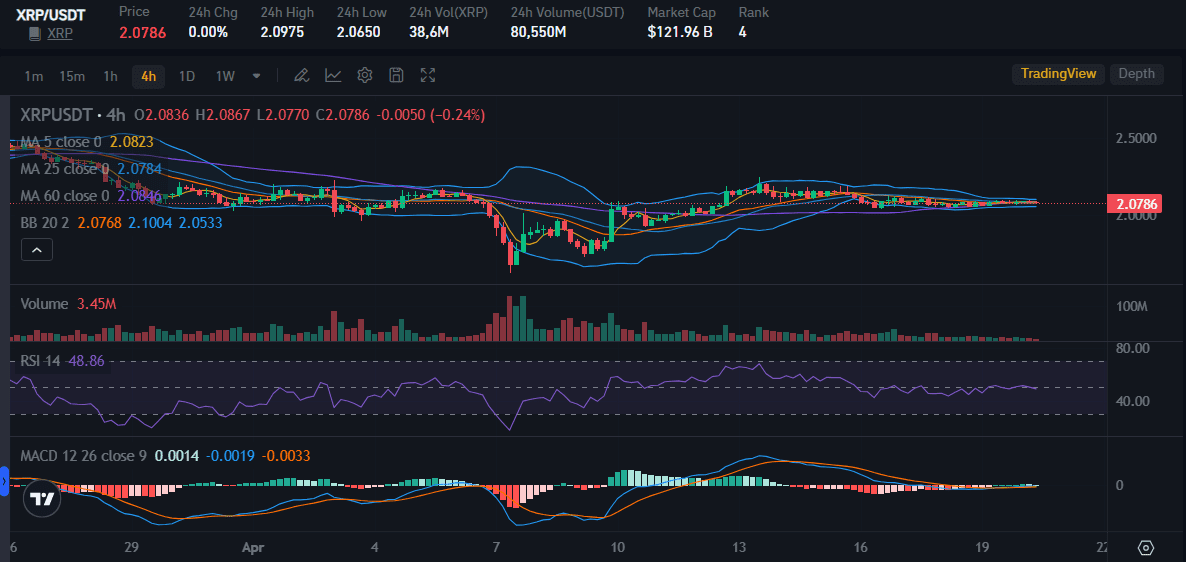
XRP’s price action this week has been a tight dance between $2.00 and $2.24, with the latest tick resting just above $2.08. This follows a remarkable 327% annual gain, having climbed from just $0.49 five months ago.
While this trajectory marks significant progress, the crypto community remains divided—some hopeful for further upside, others frustrated by what feels like stagnation in the face of promising news.
Despite the broader market showing early signs of strength—Bitcoin hovers near $84,000 and Solana (SOL) leads altcoin gains—XRP’s story is more nuanced. Its current momentum hinges heavily on legal resolution and institutional validation.
ETF Speculation Ignites Institutional Curiosity
Perhaps the most bullish narrative right now revolves around XRP’s potential for an exchange-traded fund (ETF). Financial giant Franklin Templeton recently amended its spot XRP ETF filing, quietly signaling sustained interest.
While the U.S. Securities and Exchange Commission (SEC) has yet to greenlight the proposal, the move drew immediate attention.
Approval of a spot XRP ETF could dramatically alter its investment profile, inviting billions in institutional capital. Following the success of Bitcoin ETFs earlier this year, which helped BTC rally to new highs, XRP is now viewed as the next contender.
Several firms—including Bitwise, Grayscale, and ProShares—have shown active interest in launching XRP-backed financial products.
Legal Progress: The Ripple vs. SEC Saga Nears a Climax
A breakthrough in the long-standing Ripple-SEC legal battle might finally be on the horizon. On April 10, both parties filed a joint motion to pause ongoing appeals in favor of a settlement discussion.
This followed the appointment of Paul Atkins, a crypto-friendly figure, as the new SEC Chair—fueling optimism that the agency’s stance toward digital assets may soften.
Further developments came on April 16, when the U.S. Court of Appeals granted a motion to hold the appeals in abeyance, suggesting that a resolution could be imminent. Ripple’s legal team indicated that the SEC had agreed to drop its appeal, while Ripple will relinquish its counter-appeal.
Additionally, the SEC plans to lift the injunction previously placed on institutional XRP sales—a move that could significantly accelerate adoption in the United States.
Legal commentators like Bill Morgan and Fred Rispoli hint that the next big announcement could be the formal modification of the judgment, including a reduction in Ripple’s fine and full clearance for XRP institutional sales.
This would not only remove a major legal overhang but potentially unlock a path toward ETF approval.
Investor Psychology: Between Hope and Unrealistic Expectations
Despite all these promising indicators, many XRP holders remain frustrated. Crypto figure Edoardo Farina, founder of Alpha Lions Academy, recently commented on this contradiction.
He acknowledged that even if XRP were to surge to $50—a level that would imply a $5 trillion market cap—some investors would still call for $100. He argues that this constant chase for higher prices often overshadows the real achievements.
According to Farina, the key issue is a lack of long-term perspective. He highlights how the coin’s current price represents a fourfold increase from late 2023. Yet, many investors choose to ignore this progress, fueling a never-ending cycle of dissatisfaction.
This sentiment was echoed by other community analysts like BarriC and Amonyx, who argue that past price targets once deemed unrealistic now appear attainable.
Technical Levels and Market Catalysts to Watch
At present, XRP is hovering just above the crucial support level of $2.08. Technical charts suggest that a push past $2.20 could open the door to further upside, while failure to hold $2.04 might drag prices back to the $2.00 zone.
Recent whale sell-offs have also influenced short-term price action. Between April 1 and 14, wallets holding 100M–1B XRP offloaded over 370 million tokens. Despite this, XRP rebounded from $1.73 to $2.14 within days, signaling accumulation by smaller investors and renewed belief in its long-term potential.
Looking ahead, analysts consider $10 as a reasonable target if major catalysts—such as a favorable legal settlement, ETF approval, and broader crypto adoption—materialize.
Under sustained bullish conditions, this level could be reached within 12–18 months. Absent such triggers, the timeline may extend into 2026 or beyond.
Macroeconomic Context: Cautious Optimism Returns
Global macro sentiment also plays a role. While the U.S. Federal Reserve’s reluctance to cut interest rates has briefly rattled markets, crypto assets like Bitcoin and XRP have shown surprising resilience.
Moreover, geopolitical tensions, including the ongoing U.S.–China tech war, are creating headwinds for risk assets. This has led to heightened volatility and cautious positioning across markets.
Still, growing global liquidity and dovish long-term expectations provide a supportive backdrop. According to trader Ted, “Eventually, this liquidity will flow into crypto”—benefiting coins like XRP that boast regulatory clarity and real-world use cases.
Conclusion: A Defining Chapter for XRP
XRP is standing at a crucial inflection point. Legal clarity, ETF optimism, macroeconomic recovery, and strategic investor sentiment are all aligning to potentially reshape its future. While short-term price movements may seem underwhelming, the foundation being laid could be transformative.
The key takeaway for investors? Patience and perspective are essential. While chasing sky-high price targets might feel exciting, recognizing the milestones already achieved—and the massive upside potential unlocked by pending developments—may offer the most rewarding mindset.
With the legal fog finally lifting and institutional doors starting to open, XRP’s next chapter could be its most defining one yet.
by | Apr 17, 2025 | Business
Rabobank’s Rabo Client Councils have partnered with rural training provider AgriFocused to deliver farm business skills for primary producers in NSW, Victoria and Tasmania.
The practical online Farm Office Plus program provides tools to improve management of the “office side” of farming businesses.
The hands-on training aims to assist with establishing easy record-keeping systems, streamlining bill payment and bookkeeping, reduce accounting fees, minimise filing time and develop time management skills.
The initiative has been spearheaded and funded by food and agribusiness banking specialist Rabobank’s Rabo Client Councils, a group of innovative, forward-thinking clients who are passionate about making a difference in their communities and who support initiatives with the goal of making a meaningful impact on the vibrancy and resilience of rural Australia.
Through the support of the NSW and Victoria and Tasmania Rabo Client Councils, farm businesses can sign up for Farm Office Plus training at a discounted price. Course participants do not have to be Rabobank clients. The discounted positions are limited to 160 and will be distributed in order of registration.
Rabobank’s NSW Client Council member and Gunning-based sheep and cattle producer Lucy Knight said there is a “need and thirst” amongst farmers to build office administration skills.
“Many farming businesses are becoming larger, more complex and operating with fewer staff – managing the farm office is not immune from these pressures – farmers are looking for ways to streamline administrative processes,” Mrs Knight said.
The Farm Office Plus training is designed for people who may have been “battling in the office for a while” and looking for an opportunity to upskill, she said.
Mrs Knight said the training aims to enhance farmers’ “non-paddock skills” and boost their confidence in managing their farm office.
The training will be delivered by AgriFocused founder Carmen Quade. Ms Quade has worked as a university lecturer in accounting and agribusiness, as well as having experience in local government, focused on economic and community development and corporate governance. Together with her husband and family members, Ms Quade is a partner in a mixed farming business at Tallimba, in the Northern Riverina.
Ms Quade said the administrative requirements of running a farming business have grown exponentially.
“Staying on top of finances, managing the email load and fulfilling record keeping requirements can take a lot of time, often impacting on farm operations and family life,” she said. “Efficient and effective systems and a better understanding of tech solutions can win back hours. And timely information can lead to less stress and better decisions.”
Rabobank state manager for NSW Toby Mendl said Rabobank’s Client Councils are helping rural communities flourish.
“Alongside local Client Council members, we engage in listening and learning about the key issues that matter most to our clients, communities and the broader food and agriculture industry,” he said.
Rabobank’s Rabo Client Council network is focussed on developing meaningful grassroots initiatives to support key themes focusing on building industry capacity, championing rural-wellbeing, sustainability and strengthening the rural/urban connection.
Mr Mendl said the AgriFocused training is “empowering farmers by providing the tools and systems that help with the growing complexity of the administrative tasks associated with farming businesses. Ultimately, this allows them to make timely decisions, spend more time in the paddock and allocate more time on other aspects of their business”.
Farm businesses based in NSW, Victoria and Tasmania can sign up for the Farm Office Plus training and receive a $200 discount. This offer is available until March 2026 or until supported positions are filled.
To find out more about the program, click here
by | Apr 17, 2025 | Business
Bali, Indonesia – Travellers looking to escape the crowds and dive into natural beauty are setting their sights on Nusa Penida — a rugged island gem just off the southeast coast of Bali. With dramatic coastal cliffs, hidden coves, and crystal-clear waters, Nusa Penida offers a refreshing mix of adventure and serenity.
Whether it’s exploring iconic spots like Kelingking Beach or enjoying a slow sunset cruise, reaching Nusa Penida from Bali is easier than ever — with travel options to suit every type of visitor.
About the Nusa Islands
The Nusa Islands are a trio of islands located just a short boat ride from Bali’s mainland. Each has its own charm:
Nusa Penida

Nusa Penida is known for its raw beauty and dramatic landscapes
1. Kelingking Beach: A scenic cliff resembling a T-Rex, offering sweeping ocean views.
2. Broken Beach: A natural rock arch over turquoise waters.
3. Angel’s Billabong: A crystal-clear natural infinity pool set into the rocks.
4. Crystal Bay: A tranquil beach ideal for snorkelling and relaxing.
Nusa Ceningan

Nusa Ceningan, the smallest of the three, sits between Nusa Penida and Nusa Lembongan. With cliffside views and the famed Blue Lagoon, it’s a favourite for laid-back travellers and cliff jumpers.
Nusa Lembongan

Nusa Lembongan boasts mellow beach vibes, charming villages, and fantastic diving — perfect for those seeking both relaxation and ocean exploration.
How to Get There
Travellers can choose from two main transport options from Bali to Nusa Penida:
1. Private Boat Rental

For a seamless and personalised experience, boat rental is a premium option. Private boats offer comfort, privacy, and flexibility — ideal for families, groups, or couples wanting to island-hop at their own pace.
“Many of our guests prefer private charters for their freedom and convenience,” says Ketut Arya, a travel consultant at Bali Luxury Travel. “They can choose their departure time, avoid the crowds, and stop wherever they like — it’s truly a custom journey.”
When considering boat rentals, you can check this list reputable providers of boat rental bali that highly recommended for their reliability and stellar service.
2. Public Ferry

A budget-friendly alternative, scheduled ferries operate daily from Sanur, Padang Bai, and Kusamba. While they can be crowded and less flexible, ferries remain a reliable choice for solo travellers or those on a tighter schedule.
Tips Before Booking a Boat
1. Know Your Purpose: Choose your vessel based on your plan — whether it’s a day of island hopping, snorkelling, or a romantic sunset cruise.
2. Book Early: Secure your spot in advance, especially during holidays and high season, to avoid limited availability and price hikes.
3. Book Early: Secure your spot in advance, especially during holidays and high season, to avoid limited availability and price hikes.
4. Check Weather Conditions: Monitor the marine forecast and be prepared to reschedule if conditions are rough. Calm seas make all the difference.
5. Use Reputable Operators: Select licensed providers with strong reviews, transparent pricing, and appropriate insurance.
A Must-Do While in Bali

Planning a visit to Nusa Penida is increasingly seen as a must-do experience for anyone holidaying in Bali. With stunning natural backdrops and easy travel options, the Nusa Islands are a perfect escape from the hustle — just an hour away by boat.
“There’s something magical about sailing out from Bali and arriving in a place that still feels untouched,” adds Arya. “It’s the side of Bali most travellers don’t expect — and never forget.”
by | Apr 17, 2025 | Business
Kuala Lumpur, Malaysia – 26th March 2025 — Crewstone International Sdn Bhd, a PEMC-licensed private equity firm, and Vince Group, one of Malaysia’s leading integrated real estate developers, are proud to announce the launch of a strategic partnership to establish a RM150 million Real Estate Investment Fund — marking a major milestone in the country’s investment and property landscape.
This newly established fund will pioneer Malaysia’s first fully integrated real estate investment ecosystem, enabling investors to participate in a seamless, end-to-end property investment platform — from acquisition and development to value enhancement and exit realization.
“This partnership sets a new benchmark for real estate investment in Malaysia. By combining our investment structuring capabilities with Vince Group’s robust property ecosystem, we are unlocking a future where real estate investing is smarter, scalable, and more accessible,” said Ahmad Izmir, CEO of Crewstone International.
The fund will focus on high-yield, risk-mitigated real estate opportunities throughout Malaysia, with an emphasis on capital preservation and attractive upside potential for both institutional and qualified investors.
“We’re proud to collaborate with Crewstone to bring a bold vision to life — a one-stop, future-ready real estate platform designed to generate long-term value,” said Dato’ Vincent Nee, Group Managing Director of Vince Group. “This RM150 million fund is more than a financial vehicle — it’s a revolution in how real estate investment is approached in Southeast Asia.”
The signing ceremony, held in Kuala Lumpur, was attended by key stakeholders, and investors — marking the formal launch of this ambitious initiative. The partnership is expected to catalyze innovation within Malaysia’s real estate and alternative investment sectors, while offering robust returns to aligned partners.
About Crewstone International
Crewstone International is a private equity and investment management firm licensed under the Securities Commission Malaysia (License No. VCPE/0099/2023). With over MYR 500 million in assets under management, Crewstone specializes in cross-border private equity, credit, and fund strategies with a focus on delivering value for institutional and government partners.
About Vince Group
Vince Group is a diversified property group with an end-to-end ecosystem across development, marketing, leasing, and hospitality. With a track record of transformative real estate projects across Malaysia, the Group is known for innovation, execution excellence, and a strong commitment to shaping the built environment.
by | Apr 16, 2025 | Business
Victoria’s biggest celebration of heritage returns on Friday, 18 April, with the launch of the Australian Heritage Festival (Victoria) – presented by the National Trust of Australia (Victoria) and proudly supported by the Heritage Council Victoria and the Victorian Goldfields World Heritage Bid.
Running until Sunday, 18 May, the festival features more than 300 free and ticketed events across Victoria and invites visitors to explore the people, places and cultures that have shaped the state’s rich story.
This year’s theme, Unearthed, brings to light hidden histories and untold stories – highlighting the contributions of migrant and queer communities, as well as the lasting legacy of women who helped build and shape our cities and towns.
The month-long program offers something for everyone, with walking tours, exhibitions, workshops, and family-friendly experiences spanning urban centres and regional towns. Visitors can step inside historic homes, board vintage trains, or uncover the secrets of Victoria’s gold rush past.
Festival highlights include The Alchemy of Gold forum in Campbells Creek from 16 to 18 May, which will examine how the 1850s gold rush transformed Victoria. Historians, experts, and community members will explore the profound and lasting impact of this era on the state’s identity.
In Geelong, The Heights Heritage Skills & Traditions Autumn Fair on 26 April offers visitors a chance to step back in time with heritage gardens, traditional crafts, and hands-on demonstrations that showcase skills passed down through generations.
In Bendigo, families can enjoy The Heritage Fiesta on 17 May, with free entry to iconic sites including the Central Deborah Gold Mine, Bendigo Tramways, and the Bendigo Joss House Temple.
At Melbourne’s Trades Hall, special heritage tours on 21 and 28 April and 5 and 12 May invite visitors to walk in the footsteps of labour movement icons such as John Curtin, Zelda D’Aprano and Bob Hawke, while learning about more than 150 years of workers’ rights history.
Visitors can also gain exclusive access to behind-the-scenes Tours of the See Yup Temple in South Melbourne on 4 May. Historian and curator Dr. Sophie Couchman will guide guests through the fire-damaged temple, sharing insights into its restoration and showcasing rare heritage objects up close.
The 2025 Festival also comes at a significant moment for Victoria, following the addition of the Victorian Goldfields to Australia’s World Heritage Tentative List – a major milestone in recognising the global significance of the state’s gold rush legacy.
The Australian Heritage Festival runs from Friday 18 April to Sunday 18 May 2025. Full program details are available at: www.nationaltrust.org.au/ahf/vic
The festival is proudly presented by the National Trust of Australia (Victoria) in partnership with the Heritage Council Victoria and the Victorian Goldfields World Heritage Bid.





You must be logged in to post a comment.